
What Is Capillary Flow Porometry (CFP)?
Capillary flow porometry is optimal for analyzing pores that directly contribute to fluid transport (open, permeable, or through-pores). It has a wide dynamic range of measurable pore sizes and the unique ability to determine through-pore gas permeability and bubble point. Measurements of larger pores are much faster than acquiring gas adsorption isotherms (~30 minutes versus 8-24 hours), which is necessary for nanoscale porous materials.
Other details:
- Must be a solid material with gas-permeable through-pores.
- Must be completely wettable by a liquid suitable for analysis.
- Pore size range between ~ 0.02 to 500 µm.
- Must be sealable using an O-ring – not too rough and rigid.

Rapid Measurements
Rapid Measurements
Ideal for applications like filtration media.

Non-Destructive
Non-Destructive
Non-destructive and non-toxic analysis conditions.

Wide Measurement Range
Wide Measurement Range
Wide dynamic measurement range.
Why Use CFP?
- Pore size and gas permeability determination of through-pores in permeable materials.
- Determine the pore size distribution in the size range of: ~0.02 to 500 µm.
- Bubble point, cumulative flow percent, and pore density determination.

Measure the Pores That Matter
Analyze only open, flow-relevant through-pores.

Fast, Non-Destructive Testing
Get accurate results in minutes, not hours.

Full Performance Insight
Assess pore size, bubble point, and gas permeability.


Working Principle
A porometry measurement involves first thoroughly wetting the sample with an appropriate wetting solution. This fluid fills the pores and blocks gas from flowing through them via capillary forces that are described by the Washburn equation:
D=(4γ∙cosθ)/ΔP
where D is the pore/capillary diameter, is the known surface tension of the wetting liquid, θ is the contact angle between the liquid and pore surface / capillary wall (should be 0° if fully wetted), and ΔP is the differential gas pressure applied by the porometer.
The sample is sealed between a mesh support screen and an O-ring. Gas pressure is then directionally applied and ramped up. As the gas pressure increases, the wetting fluid is evacuated from more and more pores, with larger pores emptying first due to the lower capillary forces holding the wetting fluid inside. A dry run without the wetting fluid is also performed to determine which phase in the wet run aligns with when the pores have fully evacuated.
Equipment Used for CFP:
At Covalent, we use Anton Paar / Quantachrome’s highest-end 3G zH capillary flow porometer.
Anton Paar Porometer 3G zh
Key specifications:
- Minimum Detectable Pore Size: 13 nm.
- Maximum Detectable Pore Size: 500 μm.
- Flow Rate Range: 0.01 to 200 L/min.
- Flow Sensor Temperature Coefficient: < 0.5% / °C
(from 15 to 45 °C). - Maximum Pressure: up to 500 psi (34.5 bar).
- Pressure Accuracy: ± 0.05% f.s.

Key Differentiators
Strengths
- Rapid and reproducible measurements are ideal for applications like filtration media.
- Generally non-destructive and non-toxic analysis conditions.
- Wide dynamic range of measurable pore sizes.
- Only measures open, permeable pores which are relevant to fluid transport.
Limitations
- Not suitable for nanoporous materials (< 20 nm).
- Pore density must not be excessively restrictive to flow.
- Pores must be open and through-connected, i.e., permeable with gas flow.


Sample Information
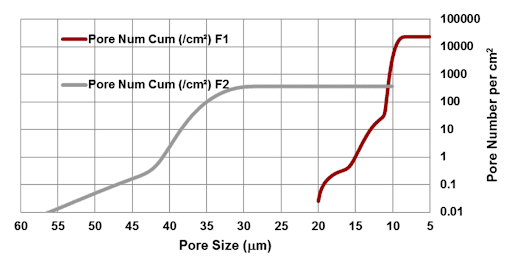
Example Pore Size Distribution for two samples, ‘F1’ (red), and ‘F2’ (gray). The calculated cumulative number of pores per unit cm2 is plotted as a function of Pore Size in microns. Sample F1 shows a higher proportion of pores with size < 10 μm, and Sample F2 shows a broader distribution of pore sizes (from 10 to 55 μm) as well as a greater total porosity.
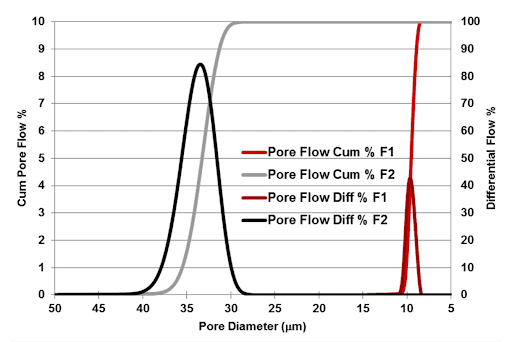
Example plot of cumulative flow % and differential flow % contrast with pore size for the same two samples shown above. These plots are computed from the raw flow rate data and can be used to analyze minimum, maximum, and average pore sizes in each sample. Sample F1 has average through-pore diameter of 9.5 μm and Sample F2 has an average through-pore diameter of approximately 33 μm.
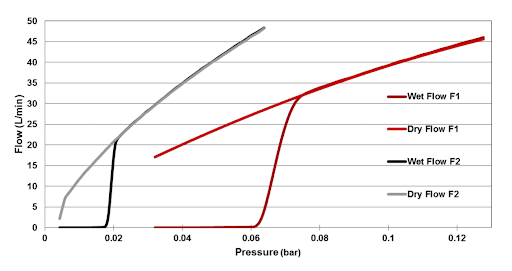
Raw Flow Rate versus Pressure data for the samples F1 and F2 shown above. These are collected in two phases: a wet-flow state (during liquid displacement) and dry flow state (after all liquid is removed).
What we accept?
The sample must be a solid material with gas-permeable through-pores. The standard size is 25 mm with a maximum thickness of 3 mm (other configurations may be possible). The sample must be completely wettable by a liquid suitable for analysis. A pore size range between ~0.02 – 500 µm is generally accepted. The sample must be sealable using an O-ring; not too rough and rigid, but able to withstand 100+ psi of gas pressure during analysis.
Use Cases
Battery Separators
Must be permeable to ions to allow charge to move, while providing a non-conductive barrier that stops direct contact between the anode and cathode. Porometry can probe this permeability, though pore size limitations may come into effect in some configurations.

Filtration Media & Membranes
Capillary flow porometry is ideal for analyzing the proper construction and performance of filters and membranes. This includes pore maximum, minimum, and average sizes, pore-size homogeneity, and gas permeability. These filters allow materials of specific sizes to flow efficiently while catching or removing all larger debris.

Textiles
Porometry can be an important technique to test the breathability of textiles by characterizing the pore sizes and gas permeability. This is important for the comfort and safety of the wearer, as heat and air must pass primarily one-way through the material while preventing precipitation, debris, or other material from passing into or through the material.
Complementary Techniques
- Gas adsorption or BET: Gas adsorption is another Porosimetry technique optimal for analyzing solid materials’ specific surface area and pore size distribution with pores of all types, ranging from approximately 0.35 to 50 nm in size.
- Mercury Intrusion Porosimetry (MIP): This technique is very similar and complementary to porometry, although it analyzes all types of pores, including nanoscale pores. It can obtain surface area, total porosity, and pore size distributions.
- Solid Surface Zeta Potential: The surface charge of fabrics, textiles, and, in some cases, membranes can play a key role in their performance, alongside the characterization of the through-pores in these materials via capillary flow porometry.
Why Choose Covalent for Your CFP Needs?
We offer several complementary techniques for completely characterizing the pores in our clients’ materials of interest and other physical and chemical properties related to the material performance. At Covalent, we can prepare samples in-house to make them measurable and ultimately deliver the valuable data you need.
Frequently Asked Questions
Identifying the right test can be complex, but it doesn’t have to be complicated.
Here are some questions we are frequently asked.
What pore size range can Capillary Flow Porometry (CFP) accurately measure?
CFP can generally measure pores from 0.02 µm to 500 µm, depending on the material, pore density, and setup.
How is the bubble point determined in capillary flow porometry?
The bubble point is the pressure at which the largest pore empties the liquid and allows continuous gas flow first. This is identified during the wet run and confirmed against the dry run.
What are the common wetting fluids used in CFP?
Common wetting fluids include proprietary universal wetting agents such as Porofil, as well as simple solvents like water. In general, any non-interacting liquid with a well-defined surface tension and complete wetting properties can be a suitable wetting fluid for use in CFP.
Can CFP test both flat-sheet membranes and hollow fiber filters?
Yes. Standard sample geometries are flat, 25 mm diameter discs up to 3 mm thick, but other geometries may be possible depending on sealing and equipment configuration.
What standards govern CFP testing?
ASTM F316 is one common standard that uses capillary flow porometry to determine the pore size characteristics and bubble point of membrane filters. Others may also be applicable.
How does the mean flow pore diameter differ from the bubble point measurement?
The bubble point reflects the largest pore that opens first under gas pressure. The mean flow pore diameter represents the pressure at which 50% of the total flow has passed, giving an average functional pore size.
Is CFP a destructive test?
CFP is not generally considered destructive, although samples may need to be cut to fit the testing sample holder, and can be damaged by the tight seal against the O-ring on the edges.
How long does a full CFP test typically take?
Once the instrument configuration is set up appropriately for the pore sizes of the sample being tested, the runs take about 30 minutes for most samples, compared to approximately 8–24 hours for gas adsorption techniques.
Can CFP evaluate filter integrity for cleanroom or sterile applications?
Yes. CFP can assess pore size distribution, bubble point, and gas permeability, which are critical parameters for confirming filter performance and integrity.

Resources