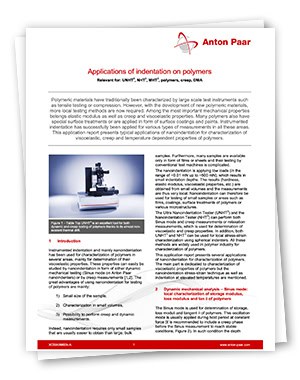

What Is a Nanoindentation Test?
Nanoindentation characterizes the hardness and elastic modulus of thin films or coatings. It can measure mechanical properties with micron spatial resolution, which is useful for site-specific locations on a device.
It achieves this by measuring a small force (1 µN to 100 mN) and displacement (1 nm to 10 µm) between the indenter tip and the sample surface and then calculating the mechanical properties. By analyzing the load-displacement curve, nanoindentation reveals how materials deform under stress, helping engineers and researchers optimize coatings, films, and device surfaces.

High-Resolution Mechanical Testing
High-Resolution Mechanical Testing
Measures hardness and modulus of thin coatings.

Dynamic Analysis Capability
Dynamic Analysis Capability
Uses dynamic mechanical analysis (DMA) or SINUS mode with Covalent’s instrument.

Temperature-Dependent Profiling
Temperature-Dependent Profiling
Evaluates mechanical properties as a function of temperature.
Why Use Nanoindentation?
Our nanoindentation analysis system provides a comprehensive suite of measurements, with load versus force displacement as the primary output. It includes elastic modulus, hardness, creep, stiffness, yield strength, and storage and loss modulus. It also measures fracture toughness, including SEM images for analysis.
Unlike macroindentation methods such as Vickers or Brinell, nanoindentation probes the mechanical properties without influencing the substrate.

Material Compatibility
Our nano scratch testing is compatible with a variety of solid materials, ranging from plastics, metals, and ceramics, while ultra-soft materials like hydrogels or biopolymers are more challenging.

Depth Resolution: 1nm
- Load Resolution: µN .
- Lateral Resolution: Depends on the indenter’s contact depth during the test. The radius of curvature of the indenter is 100 to 200 nm.

Depth Profiling
Use sinusoidal mode or progressive multicycles to probe mechanical properties vs. depth.

Covalent’s Capabilities Offer Nanoindentation
for Quantitative Thin Film Mechanical
Analysis

Working Principle
SINUS mode is an advanced dynamic testing method that applies a sinusoidal oscillation to measure a material’s mechanical properties with high precision. The SINUS mode can convert data into stress-strain curves to identify the yield point. Covalent’s instrument features a reference indenter system for detecting surface contact, which is ideal for soft materials, and a heating stage that allows measurements from RT to 200 °C, analyzing mechanical properties at varying temperatures. During unloading, the slope of the load-displacement determines the elastic modulus, while hardness is derived from the indenter’s contact area.
Equipment Used for Nanoindentation:
Anton Paar STeP (Standard Testing Platform) 600
The Anton Paar STeP (Standard Testing Platform) 600 has three testing heads.
- UNHT3 (Ultra Nanoindentation Tester).
- Can apply a sinusoidal load profile for dynamic mechanical testing.
- Consists of a temperature control sample stage (RT-200C) for measuring hardness, modulus, and viscoelastic properties as a function of temperature.
- MCT3 (Micro-combi Tester, used for micro-indentation and micro-scratch).
- NST3 (nano-scratch tester).

Key Differentiators
Specific benefits of Covalent’s system include SINUS mode for dynamic mechanical testing and a reference indenter that maintains surface contact for precise, long-duration, or soft-material measurements.
Strengths
- Small force and displacement resolution required to measure hardness and modulus of thin coatings.
- RT–200 °C temperature profiling.
- Dynamic mechanical testing for viscoelastic materials.
Limitations
- Not suited for concave sample surfaces.
- The accuracy of ≤5 microns is challenging.
- Not suited for soft materials, but accessible through our partner lab network.
- High surface roughness can induce variation.


Unsure Whether Nanoindentation is Right for You?
Learn how nanoindentation can quantify hardness, modulus, and other nanomechanical properties in thin films and coatings, helping you design more reliable materials and devices.
Sample Information
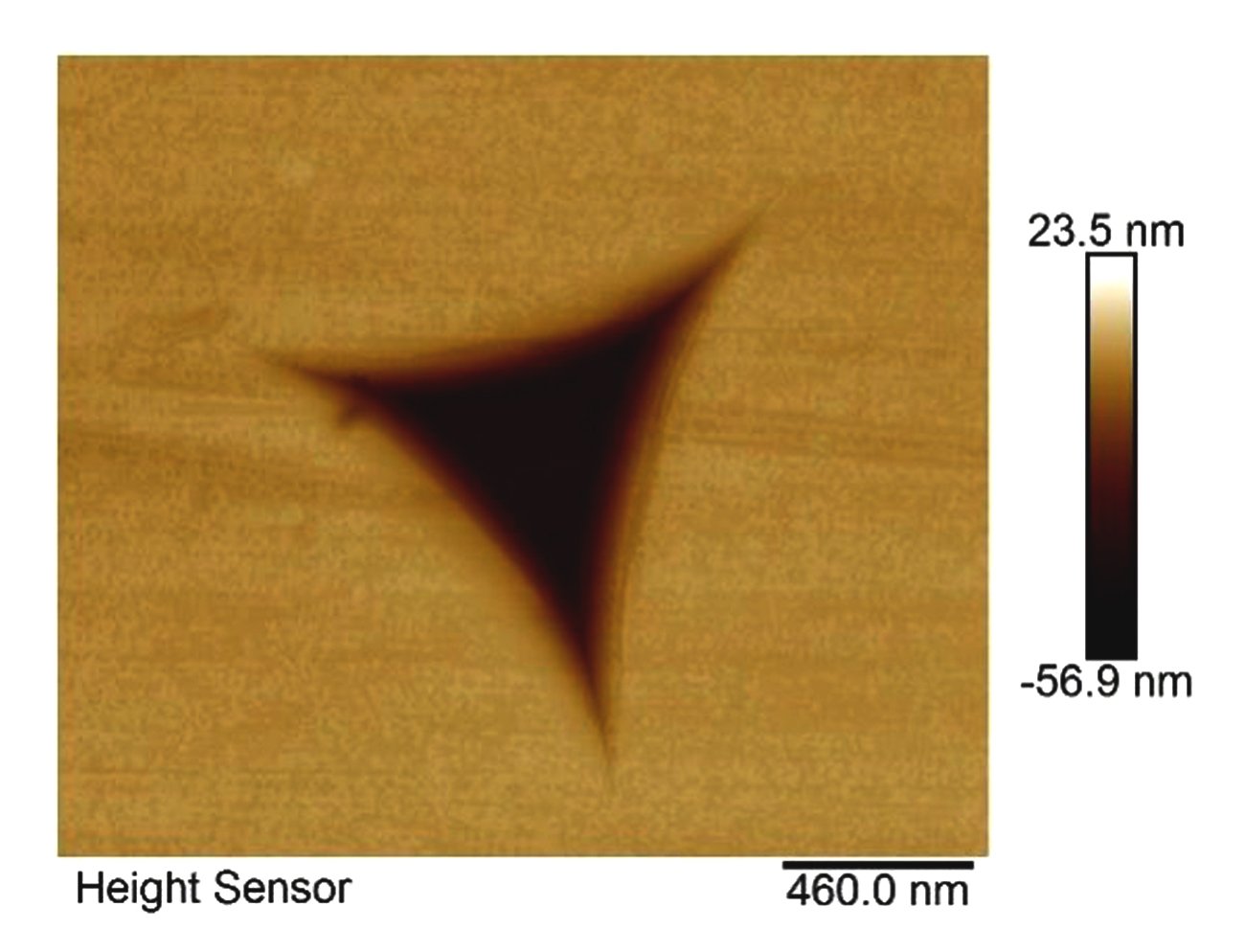
An AFM image of an indent on fused quartz was taken, which is a standard reference for tip area calibration. In this case, we took an AFM image to measure the contact depth of the indenter under a specific load.
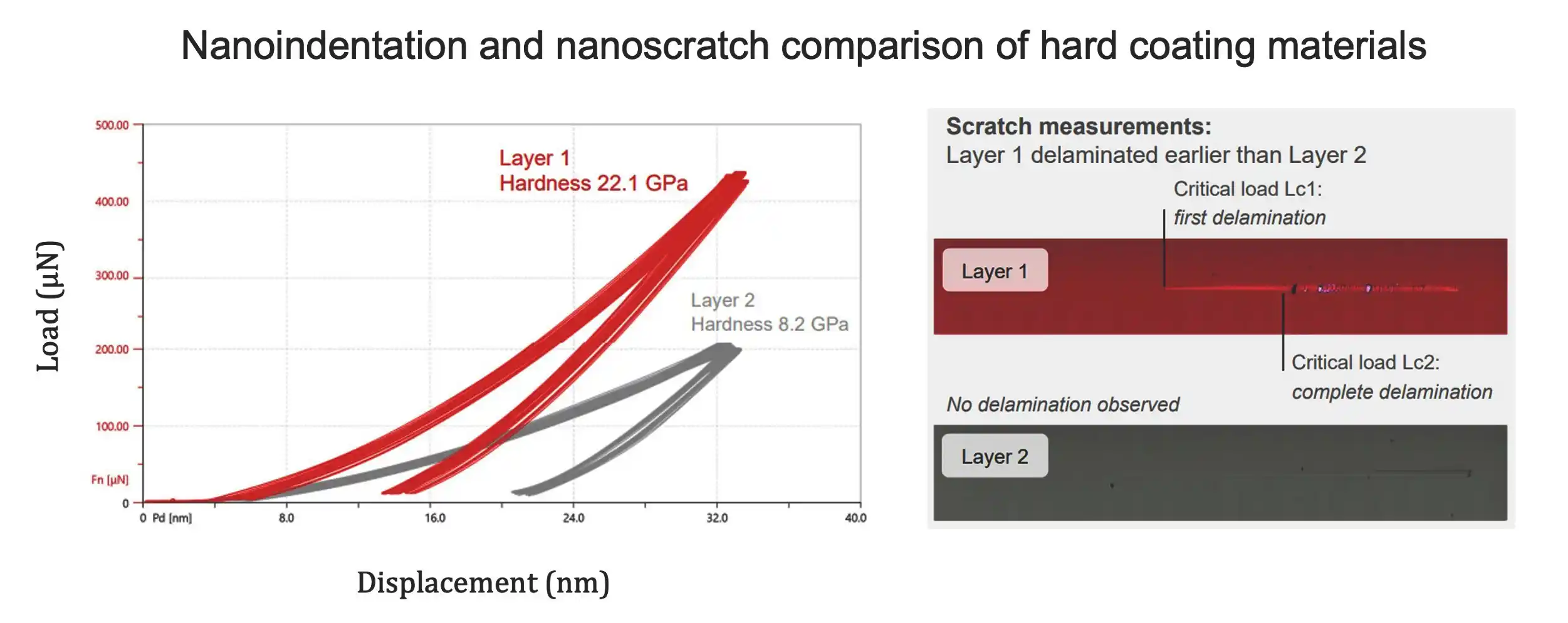
Indentation and progressive load scratch comparison of two hard coat films. Layer 1 shows a higher hardness than Layer 2, indicating that a higher load was required to displace the tip in Layer 1 the same distance as Layer 2.
What we accept:
Samples must be solid materials and ideally flat. If they are not, some mechanical preparation may be required for more reliable testing. Surface roughness may need to be analyzed to determine the correct load and contact depth. As a general rule of thumb, the contact depth.
Use Cases

Semiconductor
Mechanical properties of low k dielectric films.
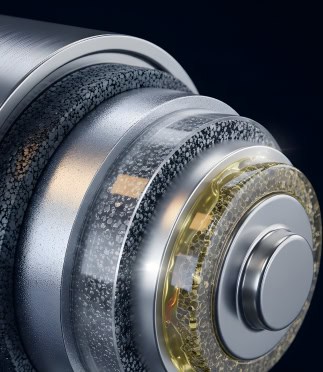
Battery
Hardness of isolated graphite particles.

Consumer Electronics
- Depth-dependent mechanical properties of polycarbonate.
- Cracking failure in OLED displays.

Medical
Loss modulus vs temperature of pressure-sensitive adhesives used in medical sensors.
Complementary Techniques
- Indentation: Complementary to chemical analysis techniques such as ICP-OES, SEM-EDS, or GD-OES. It correlates the chemical composition of the film with the mechanical properties.
- Optical Microscopy or SEM: These techniques are used to image the indent. If a customer is interested in fracture toughness, we can measure the crack length propagating from the indent edge.
- Scratch Testing: Characterizes how thin films shear or delaminate under progressive load. This is typically correlated with film hardness.
Glow Discharge Optical Emission Spectroscopy (GDOES)
Sputters surfaces to quantify composition & depth-profile layers. Explore
Inductively Coupled Plasma Optical Emission Spectroscopy (ICP-OES)
Quantifies multiple elements at very low concentrations. Explore
Scanning Electron Microscopy (SEM)
Images surface topography and composition with electrons. Explore
Why Choose Covalent for Your Nanoindent Needs?
Frequently Asked Questions
Identifying the proper test can be complex, but it doesn't have to be complicated.
Here are some questions we frequently get asked.
What properties can Nanoindent measure?
Nano-indent is suited to measuring various aspects of a given sample, including hardness, elastic modulus, creep, stiffness, yield strength, fracture toughness, storage, and loss modulus.
What types of materials can be tested?
Nano-indent is compatible with metals, ceramics, plastics, coatings, and thin films.
What is the spatial and depth resolution on Nanoindent?
Our nano-indent has a depth resolution of 1 nm, a load resolution of 1 µN, while the lateral resolution depends on the indenter’s contact depth.
What complementary techniques are useful to use alongside the nano indenter?
We suggest using optical or SEM imaging to visualize indents and cracks, as well as scratch testing to measure adhesion, shear, or delamination behavior of coatings.
Can you test mechanical properties at elevated temperatures?
Yes. Our UNHT3 system includes a heating stage for testing from room temperature up to 200°C.

Resources