
What Is Dynamic Light Scattering (DLS)?
Dynamic Light Scattering is a fast, non-destructive technique for measuring the size and uniformity of particles in suspension, from the nanoscale up to a few micrometers.
Also known as Photon Correlation Spectroscopy (PCS) or Quasi-Elastic Light Scattering (QELS), DLS calculates the particles’ hydrodynamic diameter and size distribution to assess particle aggregation, uniformity, and stability.
At Covalent, DLS is one of our core tools for quality control and material characterization. From monitoring nanoparticle dispersions to assessing protein or polymer formulations, we provide data that helps guide formulation choices and assess long-term stability.

Measurement Principle
Measurement Principle
Photon correlation of scattered laser light; autocorrelation decay links Brownian motion to diffusion and size.

Analytic Outputs
Analytic Outputs
Z-average, PDI, D10/D50/D90, autocorrelation, and intensity-weighted size distributions.

Resolution & Sensitivity
Resolution & Sensitivity
Nanometer-scale sensitivity across 0.3 nm to ~10 µm hydrodynamic diameter with multi-angle detection.
Why Use DLS?
When particle behavior at the nanoscale dictates real-world performance, DLS delivers:
- Nanometer sensitivity: Detects subtle changes in particle behavior.
- Rapid measurement: Minutes per sample, with real-time feedback.
- Non-destructive: Sample integrity is preserved.
- Low-volume compatible: Works with as little as 12 µL.
- Comprehensive output: Particle size distribution, Z-average, PDI, size percentiles, correlation function.

Stability Monitoring
Detect aggregation, size drift, and dispersion quality with replicate runs and trend analysis.

Correlative Insights
Measure size, zeta potential, and molecular mass in one workflow using DLS, ELS, and SLS.

Sample-Friendly Throughput
Rapid, non-destructive measurements with low volumes (as little as 12 µL) in native media.

Working Principle
Every particle in suspension moves randomly due to collisions with the surrounding solvent molecules and other particles. This motion, known as Brownian motion, causes laser light scattered off these particles to fluctuate in intensity.
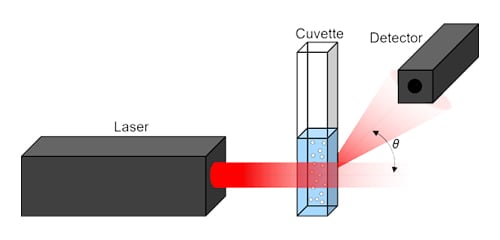
A simplified schematic of a basic DLS measurement setup, including a red laser directed at a cuvette with particles suspended in a liquid. The laser light scatters off the particles and is measured by a detector at an angle θ from the incident beam (90° as shown).
In DLS, these fluctuations are detected and represented as an autocorrelation function, which tracks how the signal loses coherence over time. The rate of decay of the signal coherence reflects particle size: faster decay indicates smaller particles, which diffuse more rapidly. This data is directly related to the translational diffusion coefficient (D, the ‘speed of the particles’), which is then applied in the Stokes-Einstein equation to determine the hydrodynamic diameter of the particles:
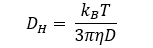
The hydrodynamic size includes both the particle and its surrounding solvation layer. We compute:
- Z-average diameter: Intensity-weighted cumulant mean.
- Polydispersity Index (PDI): Size uniformity metric.
- D10 / D50 / D90 percentiles: Key size thresholds for particle populations.
We review the data closely to identify anomalies, subtle shifts, or trends that may affect formulation performance.
Equipment Used for DLS:
At Covalent, we use the Anton Paar Litesizer 500, which integrates DLS, ELS, and SLS to measure particle size, zeta potential, and molecular weight in a single workflow, boosting efficiency and reproducibility.
Anton Paar Litesizer 500
Specifications:
- Dynamic light scattering particle size and zeta potential measurements.
- Zeta potential and molecular mass measurements via ELS and Static Light Scattering (SLS).
- Refractive index measurements.
- Measurement angles: 15° (forward scatter), 90° (side scatter), 175° (backscatter).
- Particle size range: ~0.3 nm – 10.0 μm.
- Zeta potential measuring range: ≥ ±1000 mV.
- Maximum sample conductivity: 200 mS/cm.
- Accuracy and repeatability: better than ±10% and ±3%, respectively.
- Laser light source: 658 ± 3 nm, 40 mW.
- Temperature control range: 0–90°C (±0.3°C accuracy).

Key Differentiators
All DLS measurements are performed on the Anton Paar Litesizer 500, an integrated system for Dynamic Light Scattering (DLS), Electrophoretic Light Scattering (ELS), and Statis Light Scattering (SLS).
| Parameter | Specification |
|---|---|
| Size Range | 0.3 nm to ~10 µm (hydrodynamic diameter) |
| Sample Volume | 12 µL to 2 mL (based on cuvette type) |
| Temperature Control | 0°C to 90°C ± 0.3°C |
| Detection Angles | 15° (forward), 90° (side), 175° (backscatter) |
| Laser Source | 658 nm ± 3 nm, 40 mW |
| Compatible Media | Aqueous and selected organic solvents |
| Accuracy / Repeatability | ±10% accuracy, ±3% repeatability |
| Analysis Outputs | Z-average, PDI, D10/D50/D90, Particle Size Distribution, Autocorrelation function |
| Zeta Potential Range | ±1000 mV (via ELS module) |
| Molecular Mass Range | 300 Da to 20 MDa |
We use our in-lab solvent property library and literature references to ensure accurate results across different chemistries and media.
Strengths
In solution-phase analysis, DLS stands out for its speed and sensitivity, all while using minimal material.
Key advantages:
- High sensitivity to low-level aggregation and size drift.
- Provides insight into sample uniformity and agglomeration behavior.
- Compatible with a wide range of materials and particle sizes.
- Suited for high-throughput screening.
- Enables time-course tracking and trend analysis.
Limitations
Like any analytical technique, DLS, while highly capable, has limitations that must be considered for reliable interpretation:
- Sensitive to contaminants such as dust, air bubbles, and fibres.
- Intensity-weighted outputs are based towards larger particles.
- Limited resolution for distinguishing minor subpopulations.
- Assumes spherical, non-interacting particles in calculations.
- Cannot measure particle concentration or internal structure.
- May produce inaccurate results in highly concentrated or turbid samples.
- Requires precisely known solvent properties for valid hydrodynamic sizing.
At Covalent, we address these limitations through controlled sample-prep, method prep, and cross-validation.


Unsure Whether DLS Is Right for You?
Learn how Dynamic Light Scattering supports sizing, stability, and QC.
Sample Requirements for DLS
A standard DLS output includes two key plots: the correlation function and the size distribution curve.
The correlation function reflects how fast particles diffuse based on how quickly the scattered light signal decays. A clean, exponential decay suggests stable, monodisperse samples. The size distribution shows particle sizes weighted by scattering intensity, typically on a log scale.
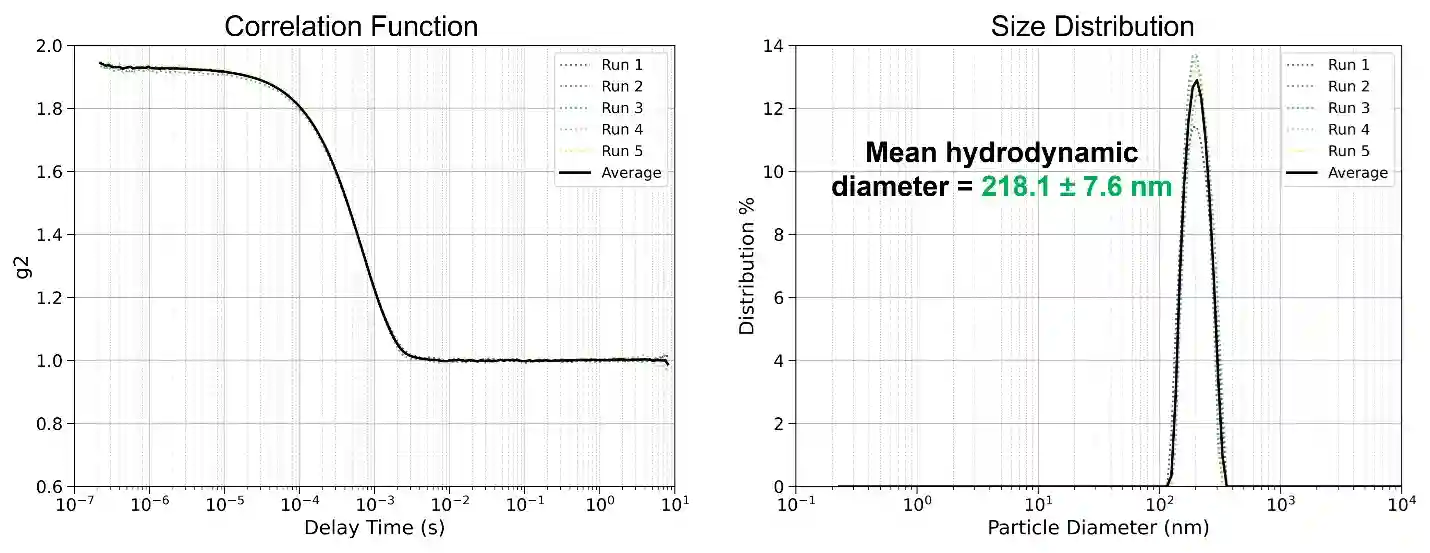
In this example, five replicate runs yield a narrow peak at ~218 nm (±7.6 nm), indicating a well-dispersed and consistent sample. The data provides key insights into aggregation, uniformity, and dispersion quality.
For reference, a downloadable sample report is available on request, containing full correlation data, z-average, PDI, and percentiles (D10/D50/D90).
What we accept:
- Sample State and Volume:
- Must be a stable liquid dispersion.
- Powders may be dispersed in non-dissolving solvents.
- Minimum volume: 12 μL, although 1.5 mL or more is strongly preferred.
- Particle Size Range:
- 0.3 nm to ~10 µm (ideal sample limitations).
- Suspensions must remain stable during measurement (stability can be assessed).
- Concentration:
- Minimum of ~0.1 mg/mL for protein systems.
- Optimal transparency: 60–80%.
- Highly turbid samples may require dilution.
- Solvent Properties:
- The refractive index (n) and viscosity (η) of the solvent must be known; particle refractive index can also help, but is not required.
- Covalent maintains an extensive solvent property library; relevant literature may also be referenced.
Use Cases
Dynamic Light Scattering at Covalent is applied across a wide range of industries, particularly where nanoscale size and stability directly impact product performance:
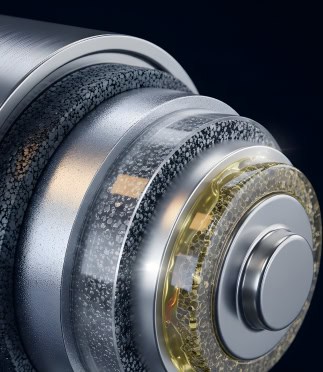
Battery Materials
- Sizing of nanoparticle or fine‑fraction active materials.
- Electrode coating stability.

Biomedical & Biotherapeutics
- Protein aggregation monitoring.
- Sizing of micelles, liposomes, exosomes, etc.
- Drug‑loaded or surface‑modified carriers.
- Virus‑like particles (VLPs) or lipid nanoparticles (LNPs).
- Scaffold particle sizing and uniformity.

Food & Beverage
- Flavorings and flavorants emulsion droplet sizing.
- Colloidal stability.

Environmental & Agricultural
- Nanoparticle or colloidal pollutant monitoring.
- Size control and monitoring of agricultural chemicals.
DLS is often paired with ELS to evaluate the effect of pH or solvent selection on particle size stability and surface charge. It is widely used for quality control, formulation, and process development, and stability studies in droplet or particle sizing across industries. DLS is also one of the few techniques that can characterize metal, polymer, and other nanoparticles, such as drug carriers or micelles.
Complementary Techniques
DLS is a powerful tool for nanoparticle sizing, but when paired with other complementary techniques, deeper insights can also be uncovered. At Covalent, we deliver many of these techniques in-house or through our extensive network of vetted partner laboratories. Some of these key complementary techniques include:
- Atomic Force Microscopy (AFM): High-resolution surface imaging and property (topographic, mechanical, electrical, morphological) mapping of particles in the nanometer to micrometer range.
- Dynamic Image Analysis (DIA): High-speed imaging that captures particle shape metrics and number- and volume-based size distributions across ~0.5 µm to 1000 µm.
- Electron Microscopy (SEM, TEM, EDS): Direct high-resolution imaging and elemental analysis of particle size, shape, structure, and porosity.
- Electrical Sensing Zone (Coulter Counter): Counts particles in the 1–1600 µm range by resistivity changes, independent of optical properties.
- Gas Pycnometry: Determines true or skeletal density and volume of solids with high precision, using minimal material.
- Laser Diffraction (LD/PSA): Measures particles from tens of nanometers to millimeters in size, delivering volume-based size distributions for powders, granules, flakes, and suspensions.
- Nanoparticle Tracking Analysis (NTA/PTA): Provides number-based size distributions and concentrations for particles ~30 nm to 1 µm in aqueous liquid suspensions.
- Single Particle Optical Sensing (SPOS): Dual light scattering/obscuration method for number and volume-based distributions of particles ~0.5 to 400 µm in dilute liquid dispersions, along with particulate concentrations.
- Sieve Analysis: Mechanical fractionation of powders >45 µm into standardized mass-based distributions.
Depending on your project goals, additional analyses such as chemical, surface, or porosity characterization may become necessary. Consult with us to help identify the right mix of methods to address your specific challenges.
You can reach out to us at info@covalent.com to discuss tailored solutions with our experts.
Atomic Force Microscopy (AFM)
Maps nanoscale topography and material properties with a sharp probe. Explore
Gas Pycnometry
Fast, precise measurements of true volume, density, and porosity. Explore
Laser Diffraction Particle Size Analysis (LD-PSA)
Analyzes particle sizes by measuring light scattering. Explore
Scanning Electron Microscopy (SEM)
Images surface topography and composition with electrons. Explore
Transmission Electron Microscopy (TEM)
Images atomic structure, defects, interfaces with sub-nm resolution. Explore
Why Choose Covalent for Your DLS Needs?
Covalent delivers accurate, high-quality DLS results with fast turnaround times and competitive pricing. We achieve this through continued investment in advanced instrumentation and deep technical expertise, enabling us to handle a wide range of samples, projects, and complex challenges.
Our team takes a rigorous, solutions-driven approach, whether through precise and careful sample preparation, working with exotic solvents, iterative method development, or customized reporting. We focus on finding the most effective path to generate reliable, actionable data.
For routine quality control and process development, we offer scalable services with flexible pricing, including volume discounts. For more complex particle analysis challenges, our broader network of capabilities positions us as a comprehensive partner, ready to solve multi-faceted problems and deliver decision-ready insights.
Frequently Asked Questions
Identifying the right test can be complex, but it doesn’t have to be complicated.
Here are some questions we are frequently asked.
Is DLS capable of detecting whether particles are or are not present in a sample?
DLS only measures the particles that meet the basic requirements of the techniques: appropriate size, concentration, and dispersion in a suitable medium. When these conditions are met, DLS reliably detects and characterizes them. If no particles are present or the sample is fully dissolved, the scattering signal will be low, noisy, inconsistent, and overfit by software algorithms. In such cases, our experts carefully review the data and flag any misleading outputs to ensure results remain reliable. DLS is not primarily intended to detect whether particles are or are not present but rather to size particles that are present.
Can DLS measure elongated or irregularly shaped particles such as proteins or nanofibers?
Yes, as long as the particles present adhere to the above sample requirements, DLS can measure them. However, data from measuring non-spherical particles may be wider in distribution or more inconsistent than uniformly distributed spherical particles, as the mathematical algorithms calculating the particle sizes assume spherical particle shapes. Even so, the data provides valuable insight for comparing stability, aggregation, or quality across samples, with appropriate interpretation of absolute sizes.
Can DLS measure particle concentrations?
No, the results from DLS are intensity-weighted, not particle numbers, because DLS is an excellent method to analyze particle behavior or changes in particle stability over time or under various conditions. So, to determine particle numbers, we recommend an alternate technique that can count particles and provide direct number-weighted distributions.
Can DLS measure the zeta potential of particles in a liquid solution?
Not by itself. While DLS analysis does not provide zeta potential information, the Anton Paar Litesizer 500 DLS instrument at Covalent can perform DLS and ELS in the same cuvette, providing particle size and zeta potential measurements simultaneously, which is particularly useful for stability testing at different pH and electrolyte concentrations.

Resources