
What Is Photo-induced Force Microscopy (PiFM)?
Photo-induced Force Microscopy (PiFM) is a cutting-edge technique that combines Atomic Force Microscopy (AFM) with tunable infrared (IR) lasers to achieve nanoscale surface analysis. This hybrid approach enables researchers to capture a sample’s topography and chemistry with unmatched spatial resolution, down to a few nanometers.
While PiFM refers to the microscopy technique, mapping nanoscale structures and chemical composition, its companion, PiF-IR (Photo-induced Force IR), is used for spectroscopy. PiF-IR provides nanoscale IR absorption spectra (like FTIR does at the macroscale). The critical difference is in scale:
- FTIR spectra reflect the average macroscopic chemical environment, smoothing over nanoscale variations.
- PiF-IR spectra capture the local chemical condition at ~5 nm, revealing chemical heterogeneity that FTIR misses.

Sub-5nm Resolution
Sub-5nm Resolution
Captures topography and chemical data at nanoscale precision.

Non-Destructive
and Non-Contact
Non-Destructive
and Non-Contact
Preserves delicate or soft samples during analysis.

Simultaneous AFM and IR Data
Simultaneous AFM
and IR Data
Provides combined nanoscale chemical and topographical insights.
Why Use PiFM?
Photo-induced Force Microscopy (PiFM) provides unmatched nanoscale chemical and topographical analysis with sub-5nm resolution, enabling the detection of ultrathin layers, nanoscale defects, and chemical heterogeneity that conventional methods miss. Its non-destructive, non-contact approach works on sensitive materials like polymers, semiconductors, and biomolecules, delivering high-resolution, actionable data for research, quality control, and advanced material development.
Key Technical Parameters:
- Simultaneous IR data and AFM data.
- AFM for the usual topographic information of the sample surface.
- IR produced spectral data of the surface.
- PiF-IR spectra.
- PiFM image at a fixed wavenumber.
Material Compatibility:
- Organic, Inorganic, and biological materials.
- IR absorption cannot identify pure metals. However, other metal-based inorganic materials can be identified (e.g., metal oxides).
Spatial Resolution:
- Sub-5nm spatial resolution for chemical analysis.
- Use PiFM if conventional or well-established techniques do not provide enough nano-chemical spatial (or depth) resolution. Use PiFM if other techniques were tried first, then move to SEM or ToF-SIMS, etc.
- The techniques mentioned are applicable only if the sample is known to have nano-chemical structures beyond those techniques.

Detect Nanoscale Defects
Reveals ultrathin residues and process variations invisible to conventional methods.

Broad Material Compatibility
Works with polymers, semiconductors, biomaterials, and thin films.

Actionable Insights
Enables precise chemical mapping for QA, regulatory compliance, and advanced research.


Working Principle
A pointed, metal-coated probe in PiFM – whose tip radius can be as small as 20 – 30 nm after the metal coating is applied – is set very close to the surface of the sample. The area immediately underneath the tip is illuminated by an exactly focused laser beam, which creates a localized electromagnetic near field. The near field then acts on the sample’s molecule, creating localized polarization based on the optical and chemical characteristics of the material.

Simple PiFM diagram. An excitation laser shown onto the sample surface allows photo-induced force detection via the AFM ©Molecular Vista.
This interaction between the tip and the polarization sample generates an extremely minute attractive dipolar force, which we refer to as the photo-induced force. The laser is modulated at a specific frequency so that the AFM probe can act as a mechanical amplifier of the photo-induced force. In scanning the tip across the surface and measuring these forces continuously, PiFM generates high-resolution maps that register surface topography and spatially resolved chemical contrast in parallel. We can keep the tip stationary and sweep the laser to collect a PiF-IR point spectrum.

The raw signal from the AFM photodiode has both the topography and PiFM signals combined. These two signals correspond to eigenmodes of the cantilever which allows independent detection after the signals are separated ©Molecular Vista.
Equipment Used for PiFM:
VISTA 150 by Molecular Vista
- PiF Laser: QCL (770 to 1840, 1995 to 2395 cm−1).
- Stage and scanner:
- Sample stage travel: 150 mm × 150 mm square.
- Scan size: 90 µm × 90 µm.
- Dual Z Feedback: 12 µm z-scanner (sample) with 600 nm fast-z scanner (tip) provides both high bandwidth and a large z-range.
- Functionality:
- Imaging modes: Non-contact AFM, PiFM, KPFM, cAFM, nano DMA, FvD (force vs distance) mapping.
- Spectroscopy modes: PiF-IR, FvD.
- There are two basic modes:
- Surface Mode: measures up to 20 nm of depth of material.
- Bulk Mode: measures up to 1000 nm of depth of material.

Key Differentiators
Strengths
No other technique can provide such nanoscale (and some sub-nano) resolution in a non-destructive and non-contact manner for surface analysis, for samples in ambient air conditions with relatively ease of use compared to conventional techniques.
- Surface chemistry and topography at nanoscale resolution.
- Surface chemistry and topography at single-digit nanoscale resolution.
- Ability to measure chemical information (not elemental).
- Non-contact and non-destructive, even more than SEM/EDS.
- Ability to measure in ambient air environments.
- Full-size wafer compatibility.
- Minimal or no sample preparations.
- Ease of use (vs. similar techniques) for nanoscale chemical measurements.
Limitations
- Not well suited to pure metals and some 2D materials without IR-active peaks.
- Accessibility of the sample surface is limited by the probe’s dimensions.
- Due to the mechanical scanning, the imaging mode can be considered slow compared to optical and even electron microscopes.
With Covalent’s diverse instrumentation and its technical team’s extensive technical experience and know-how, PiFM is a strong complementary capability that enhances Covalent’s value proposition to customers.


Unsure Whether PiFM Is Right for You?
Photo-induced Force Microscopy (PiFM) offers non-destructive, nanoscale chemical and topographical insights with sub-5nm resolution, perfect for advanced analysis in semiconductors, polymers, life sciences, and beyond.
Sample Information
- IR spectral data – chemical information similar to FTIR output.
- AFM images & topography.
- PiF-IR images & chemical mapping.
- Single wavenumber (WN) image.
- Multiple WN images overlaid.
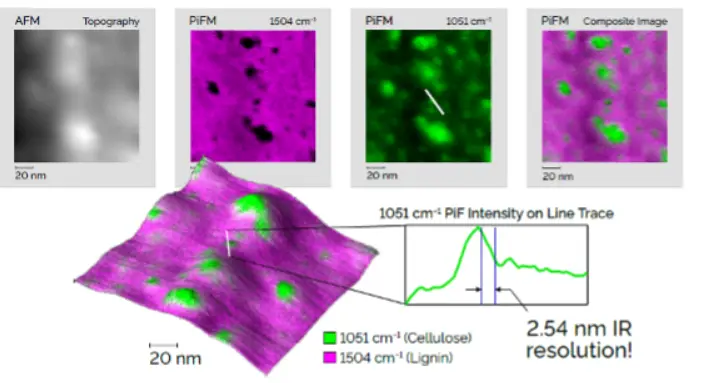
PiFM measurement on a wood cell
Scan dimensions: 150x150x 10.5nm. A zoomed-in region of the spruce wood cell wall. PiFM images show the chemical distribution of lignin and cellulose on the surface. A line trace plotting the intensity of the data in the green image shows IR spatial resolution of less than 5nm. © Molecular Vista.
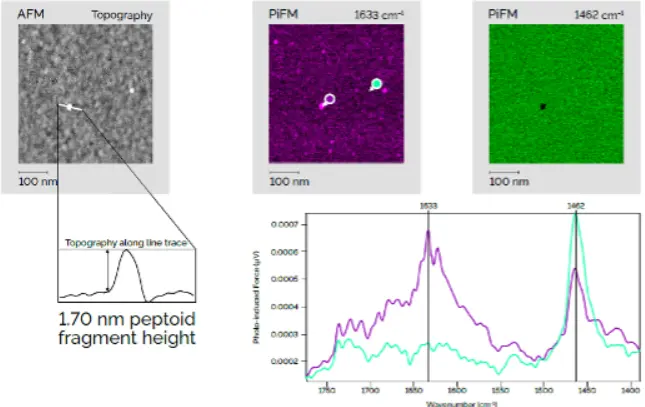
Identification of organic contamination
Scan dimensions: 500x500x1.7 nm. A PiFM image was taken at 1633cm-1, which should highlight any peptoid molecules present, like one shown on the scan of only 1.7nm tall. The black spot in the green PiFM image shows that the fragment is sitting on top of the substrate material. © Molecular Vista.
What we accept:
- Physical form: Solids only; liquids generally not measured; gases not measured.
- Sample properties: Solids and gel-like liquids must be stable in a controlled environment.
- Sample size: From small pieces mounted on a coupon (1″ x 1″) up to 300 mm wafers.
Others:
- Sample Storage/Transport: PiFM is surface sensitive enough to detect a monolayer of molecules. Do not use Gel-Pak sample containers when shipping, as they will outgas and contaminate the sample surface. Use Fluoroware or Natural Polypropylene. Please use metal tapes with acrylic adhesive if the sample needs to be secured for transport.
Use Cases

Semiconductor Defect Analysis
PiFM detects sub-5nm defects and ultrathin residues without damaging sensitive wafers, making it indispensable for chipmakers and equipment suppliers seeking reliable nanoscale process validation and failure analysis.
Polymer & Materials Science
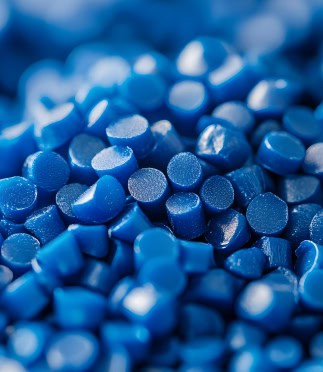
Researchers utilize PiFM to map nanoscale chemical variations in advanced polymers and composites, enabling precise formulation, uniformity checks in thin films, and identifying structural heterogeneity that traditional methods may miss.

Life Sciences & Biology
PiFM provides high-resolution chemical mapping of biomolecules and soft materials in ambient conditions, supporting studies of proteins, membranes, and synthetic biopolymers where non-destructive analysis is critical.

Pharmaceutical Development
In drug research, PiFM identifies the nanoscale distribution of active compounds within formulations, helping improve stability, efficacy, and delivery by revealing invisible chemical interactions to bulk analysis methods.

Energy & Nanotechnology
From battery electrodes to 2D nanomaterials, PiFM characterizes chemical and structural variations at the nanoscale, guiding breakthroughs in energy storage, nanofabrication, and next-generation sustainable technologies.
Complementary Techniques
- Atomic Force Microscopy (AFM): PiFM builds on AFM by incorporating chemical mapping into its topographical and mechanical analysis, thereby enabling more comprehensive surface characterization.
- Fourier-Transform Infrared Spectroscopy (FTIR): PiFM offers spectral resolution 10⁹ times higher than FTIR, isolating nanoscale chemical signatures and revealing details traditional methods miss.
- Optical Microscopy: Optical Microscopy is fast and affordable, but lacks detailed insights into surface features. PiFM enhances imaging by combining nanoscale chemical data with high-resolution visuals.
Atomic Force Microscopy (AFM)
Maps nanoscale topography and material properties with a sharp probe. Explore
Fourier Transform Infrared Spectroscopy (FTIR)
Rapid, non-destructive molecular fingerprinting across materials. Explore
Why Choose Covalent for Your PiFM Needs?
Frequently Asked Questions
Identifying the right test can be complex, but it doesn’t have to be complicated.
Here are some questions we are frequently asked.
How long does a typical PiFM measurement take?
Depending on scan size and resolution, it can take a few minutes to a few hours.
Are there size limitations for samples in PiFM analysis?
PiFM analysis covers samples from a few mm up to 300mm wafers.
Can PiFM detect chemical variations in mixed-material samples?
Yes, it provides nanoscale chemical contrast and spectra to resolve different components.
Is specialized training required to interpret PiFM data?
Yes. Basic AFM knowledge is helpful, but spectral interpretation often requires specialized expertise.