
What Is SNOM-Raman?
SNOM‑Raman (Scanning Near‑field Optical Microscopy combined with Raman Spectroscopy) focuses a laser into a 100 nm nanoscale aperture on a specially designed probe to generate near‑field light.
This light irradiates the nearby sample, enabling acquisition of Raman spectra with spatial resolution down to 100 nm—far beyond traditional Raman—making it ideal for mapping stress and chemical structure in semiconductors and ceramics at the nanoscale.
Other Details:
- Enables nanoscale chemical imaging of complex surfaces.
- High-resolution mapping for microeletronics reliability.
- Supports cross-sectional stress analysis in devices.
- Compatible with multi-layered semiconductor structures.

100 nm True Near‑Field
100 nm True Near‑Field
Breaks the diffraction limit for nanoscale Raman maps of stress and chemistry.

Interface‑Sensitive Insights
Interface‑Sensitive Insights
Resolves strain at patterned features and layer interfaces unseen by micro‑Raman.

Non‑Destructive and Correlative
Non‑Destructive and Correlative
AFM‑guided near‑field Raman maps co‑registered with topography for richer interpretation.
Why Use SNOM-Raman?
- Much higher spatial resolution than conventional Raman spectroscopy.
- SNOM-Raman is a powerful technique when the spatial resolution of conventional micro-Raman spectroscopy, typically on the micrometer scale, is insufficient.
- Common Applications: Evaluation of stress and chemical structure for semiconductors and ceramics sample.

Nanoscale Stress Quantification
Derives stress from Raman peak shifts with ~100 nm spatial sampling.

Cross‑Section Depth Mapping
Profiles stress vs. depth across multilayer stacks and device cross‑sections.

Semiconductor and Ceramic Optimized
Proven performance on Si/SiO₂ and advanced ceramics for reliability and process analysis.


Working Principle
Spatially resolve stress by measuring Raman peak shifts with 100 nm resolution. Scan semiconductor or ceramic solids, including cross‑sections, to build depth profiles. Hold the specimen flat and smooth; this ensures compatibility with the AFM probe and delivers results far more precise than conventional Raman methods.
Equipment Used for SNOM-Raman:
AFM-Raman (Horiba)
- Measurements are conducted using an original probe developed by Toray Research Center.
- A 355 nm laser is available as an excitation source.
- High spectral resolution (multi-grating, auto-switching) across wide Raman/PL ranges.
- High spatial resolution: Nanoscale spectroscopic resolution (down to 10 nm) through Tip Enhanced Optical Spectroscopies (Raman and PhotoLuminescence).
- Multi-mode SPM (AFM/cAFM/KPFM/STM), liquid cell and electrochemical environment, together with chemical mapping through TERS/TEPL. Full control of the 2 instruments through one workstation and a powerful software control, SPM and spectrometer can be operated simultaneously or independently.

Key Differentiators
SNOM-Raman offers 100 nm spatial resolution for precise stress mapping, enabling non-destructive analysis of semiconductors and ceramics. It captures nanoscale strain and chemical structure details beyond conventional Raman limits.
Strengths
- Stress measurement with a spatial resolution of 100 nm enabled by Toray Research Center (TRC)’s originally developed probe.
- Stress evaluation of semiconductors and ceramic samples.
- SNOM-Raman has 100 nm spatial resolution, being much higher than that of conventional Raman spectroscopy with a micrometer scale. This high spatial resolution enables stress evaluation in patterned some real semiconductor devices.
Limitations
- Materials with vibrational modes of low Raman activity are not well suited to this technique.
- This technique can be applied to materials exhibiting vibrational modes with high Raman activity, such as semiconductors and ceramics.


Unsure Whether SNOM-Raman Is Right for You?
Discover if SNOM‑Raman’s ultra‑fine stress mapping and nanoscale chemical insights meet your analysis needs.
Sample Information
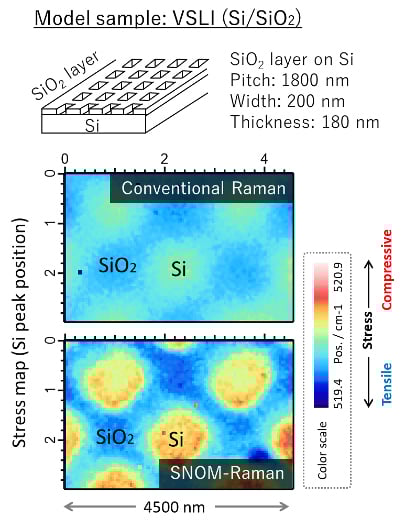
The stress map on a patterned Si device, in which a silicon dioxide layer with a grid pattern is deposited on a Si wafer. As seen here, the SNOM-Raman map showed larger stress than conventional Raman owing to the improvement of spatial resolution, and donuts-shaped compressive stress to exposed Si appears, indicating local strain concentration at the Si-SiO2 interface.
What we accept:
We accept only solid samples that are ≤ 10 mm × 10 mm in planar size and no thicker than 10 mm. The sample surface must be flat and smooth to support stable AFM probe scanning without topographical artifacts or tip damage.
Use Cases

Semiconductor
SNOM-Raman enables precise mapping of local stress in semiconductor devices with 100 nm resolution, revealing strain patterns in Si and SiO₂ layers that conventional Raman cannot detect, supporting reliability and failure analysis in microelectronics manufacturing.
Ceramic
This technique evaluates stress and chemical structure in advanced ceramics, providing nanoscale insights into microstructural features, defects, and strain distribution, critical for industries such as aerospace, electronics, and high-performance materials research.
Microstructure
SNOM-Raman maps stress in patterned or microfabricated surfaces, such as grids or complex device layouts, enabling engineers and researchers to identify local strain concentrations and optimize design, performance, and material integrity.
Multilayer Devices
By measuring cross-sectional samples, SNOM-Raman reveals depth-resolved stress and structural variations in multilayer semiconductor or ceramic devices, aiding in the development of next-generation electronics and layered material systems.
Chemical Mapping
SNOM-Raman pairs with conventional micro-Raman spectroscopy to provide both high spatial resolution and sensitive chemical detection, supporting research fields that require nanoscale chemical imaging alongside bulk material characterization.
Complementary Techniques
- Correlation of Raman and AFM / SNOM: Combining Raman with AFM or SNOM links high‑resolution stress or structural maps with chemical composition and topography, enhancing contrast and insight.
- Combination with PIFM for IR: Combining SNOM Raman with PIFM (photo-induced force microscopy) enables correlative mapping of Raman and IR active vibrational modes at the nanoscale, providing additional chemical and complementary insight information with ultrahigh spatial resolution.
- Conventional Micro‑Raman Spectroscopy: This technique delivers sensitive detection of chemical signatures over micrometer-scaleregions, making it ideal when sample Raman activity is low or when broader coverage is needed.
Atomic Force Microscopy (AFM)
Maps nanoscale topography and material properties with a sharp probe. Explore
Photo-induced Force Microscopy (PiFM)
Nanoscale chemical characterization & topography at sub-5nm. Explore
Why Choose Covalent for Your SNOM-Raman Needs?
- 100 nm resolution where it matters: We map stress and chemistry at the nanoscale, well beyond conventional Raman, so you see the strain patterns that actually drive device behavior.
- True near‑field performance: Measurements are tested with Toray Research Center’s originally developed probe, which delivers genuine near‑field Raman, not a workaround.
- Built on AFM‑Raman (Horiba) with 355 nm excitation: A robust setup for demanding nanoscale analyses on real semiconductor and ceramic samples.
- Ready for real devices: From patterned Si/SiO₂ to multilayer stacks, we quantify stress via Raman peak shifts and build depth profiles from cross‑sections.
- Practical, non‑destructive workflows: AFM‑guided near‑field maps co‑register with topography, giving you clear, interpretable results without destroying the sample.
Frequently Asked Questions
Identifying the right test can be complex, but it doesn’t have to be complicated.
Here are some questions we are frequently asked.
What is the typical turnaround time for SNOM-Raman testing?
Please inquire for typical turnaround time, expect 2-4 weeks.
Can SNOM-Raman analyze curved or irregular surfaces?
Modestly curved or irregular surfaces may be measured, though steep slopes/roughness may limit near-field coupling and map quality.
Is SNOM-Raman compatible with coated or layered materials?
SNOM-Raman is well-suited for coated/layered materials and is especially sensitive to the topmost layers’ vibrational signatures. Cross-sections can be used to analyze all the layers in the stack.
What is the maximum sample size for testing?
10x10x10mm.
How does SNOM-Raman compare to electron microscopy?
SNOM-Raman provides chemical information while electron microscopy is limited to topographic or elemental information with EDS and EELS. EM can probe with higher spatial resolution down to sub-nanometer.

Resources