
What Is Nanoscale Secondary Ion Mass Spectrometry (NanoSIMS)?
NanoSIMS is a powerful analytical technique designed for ultra-high-resolution elemental and isotopic imaging at the nanometer scale. By visualizing how elements and compounds are distributed within materials or biological samples, researchers can diagnose failures, trace processes, and authenticate materials, driving innovation in fields from semiconductors and medicine to green energy and forensic science.

Ultra-High Spatial
Resolution
Ultra-High Spatial
Resolution
Reveals elemental details at ~50 nm scale, enabling nanoscale imaging and isotopic mapping.

Simultaneous
Multi-Element
Detection
Simultaneous
Multi-Element
Detection
Detect up to seven elements or isotopes from the same sample volume in one measurement.

Trace-Level Sensitivity
Trace-Level Sensitivity
Identifies elements down to ppm–ppb levels, ideal for detecting contaminants and minor variations.
Why Use NanoSIMS?
A key feature of NanoSIMS is its exceptional spatial resolution, capable of imaging features as small as 50 nanometers. This is achieved through a coaxial lens system that positions the ion probe extremely close to the sample surface. The primary ion beam strikes the sample at a perpendicular angle (90°), while the secondary ions are extracted back through the same optical path, minimizing distortions caused by surface topography or shadowing.
NanoSIMS is equipped with up to seven detectors at the mass analyzer’s exit, six of which are movable. This configuration allows for the simultaneous detection of up to seven different ionic species originating from the same sputtered volume. Such parallel detection ensures accurate measurement of isotopic or elemental ratios and enables a direct comparison of their spatial distributions.
The instrument’s mass resolution is also outstanding, with M/ΔM values exceeding 5000. This high mass resolution allows NanoSIMS to distinguish between ions with nearly identical masses, such as 13C14N⁻ (27.000 Da) and 12C15N⁻ (27.006 Da). The use of a double-focusing Mattauch-Herzog-like geometry and optimized transfer optics ensures high transmission efficiency, even at high mass resolution, which is crucial for analyzing small volumes of complex materials.
Unlike time-of-flight SIMS (ToF-SIMS) instruments, NanoSIMS operates in direct current (DC) mode, providing sensitivity that is several orders of magnitude higher and mass resolution that is independent of the spot size. Cs⁺ beams are used for detecting negative ions (e.g., CN⁻) and O⁻ beams for positive ions (e.g., Na⁺). This flexibility allows for the analysis of a wide range of elements, though it does limit which elements can be detected simultaneously.”

Isotopic Ratio Precision
Delivers accurate isotopic measurements essential for tracer studies, geochemistry, and advanced material research.

Minimal Topography Effects
Coaxial ion optics reduces distortions, ensuring reliable data even on uneven or complex surfaces.

Versatile Application Reach
Supports diverse industries from semiconductors and life sciences to energy, geoscience, and forensics.


Working Principle
The process begins with a fine-focused primary ion beam—typically less than 50 nanometers in diameter—composed of ions such as cesium (Cs⁺) or oxygen (O⁻). This beam is rastered, or systematically scanned, across the surface of a sample. As the primary ions strike each pixel of the sample, they sputter secondary ions from the surface. These secondary ions are then collected and analyzed, allowing NanoSIMS to construct detailed, high-resolution maps of elemental and isotopic distributions.
Equipment Used for NanoSIMS:
CAMECA NanoSIMS 50L
The NanoSIMS, originally developed by Pr. Slodzian (University of Paris Sud), uses focused Cs+ or O− primary ions to sputter the sample surface. The resulting secondary ions are collected and mass analyzed with a magnetic sector analyzer, allowing simultaneous detection of up to seven ionic species from the same volume for accurate isotopic and elemental mapping.
Its compact ion optics and co-axial design enhance spatial resolution and minimize topographic effects. The double-focusing mass analyzer ensures high transmission and mass resolution, while its continuous beam mode offers superior sensitivity compared to pulsed ToF-SIMS systems.

Key Differentiators
- Surface Sensitivity: Extremely high (monolayer sensitivity).
- Mass Range: 1 to >10,000 atomic mass units.
- Molecular Detection: Yes.
- Imaging Capability: Excellent spatial visualization at nanoscale.
- Depth Profiling: Up to a few microns.
- Depth Resolution: ~10 nm.
Strengths
- Exceptional Spatial Resolution: Achieves imaging down to 50 nanometers, enabling detailed nanoscale elemental and isotopic mapping.
- High Mass Resolution: Mass resolution (M/ΔM > 5000) allows discrimination between isotopes and molecular ions with very small mass differences.
- Simultaneous Multi-Element Detection: Up to seven ionic species can be detected at once from the same sputtered volume, ensuring accurate ratio and distribution comparisons.
- Minimized Topography Effects: Coaxial geometry reduces shadowing and topography artifacts, improving data reliability.
- High Sensitivity: DC operational mode provides ppm-level detection limits and sensitivity several orders of magnitude higher than ToF-SIMS, with mass resolution independent of spot size.
- Flexible Element Detection: Positive or negative ion modes accommodate a broad range of elements and isotopes.
- 3D Analysis: Integrates spatial and depth information for full 3D chemical reconstruction.
Limitations
- Element Detection Constraints: Only ions of one polarity can be detected at a time, limiting simultaneous detection of all elements.
- Chemical State Information: Limited.
- Sample Preparation Demands: High spatial resolution and sensitivity require careful sample preparation to avoid artifacts and ensure accuracy.
- Instrument Complexity: Advanced optics and detector systems increase operational complexity and require specialized expertise.
- Limited Throughput: High-resolution mapping and multi-element detection can be time-consuming, especially for large sample areas.
- Destructive Analysis: Applies when performing depth profiling.


Unsure Whether NanoSIMS Is Right for You?
Learn more about using Nanoscale Secondary Ion Mass Spectrometry services today.
Sample Information
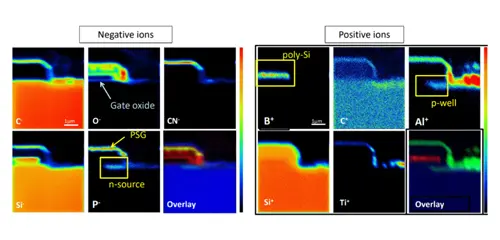
Imaging impurities in a Silicon Carbide MOSFET cross section. Phosphorous identified in the n-source and PSG; Aluminum found in p-well; and Boron found in the poly-Si electrode. The results of this NanoSIMS measurement were consistent with results of SCM and DPC-STEM analysis (not shown).
What we accept:
- Metal Samples: A very high-quality metallographic polish is essential to achieve a flat surface and a scratch-free finish, which ensures accurate analysis and minimizes artifacts in the data.
- Biological Samples: Specific protocols must be developed for each experiment to preserve both the structure and the true spatial distribution and abundance of molecules within the sample. Given the operational requirements of the NanoSIMS (ultra-high vacuum), biological samples must be vacuum compatible (volatile free), flat to reduce varying ionization trajectories, and conductive, which can be achieved by sputter coating with Au, Pt, or C. Preparation typically involves fixation using chemical fixation or cryo-fixation, embedding in resin, sectioning into thin slices between 100 nm to 1 μm, and mounting on silicon wafers or slides for analysis.
Use Cases

Semiconductor & Electronics
High‑resolution dopant mapping, contamination detection, and defect localization to ensure device reliability and manufacturing precision.

Biological & Medical
Visualizes nutrient transport, drug uptake, and isotopic tracers in cells and tissues with nanoscale chemical detail.

Green Energy
Characterizes interfaces in batteries, fuel cells, and photovoltaic materials to improve performance, stability, and lifetime.

Materials Science & Catalysts
Reveals nanoscale chemical distributions in alloys, thin films, and catalysts to guide innovation in advanced material design.
Geosciences & Planetary Science
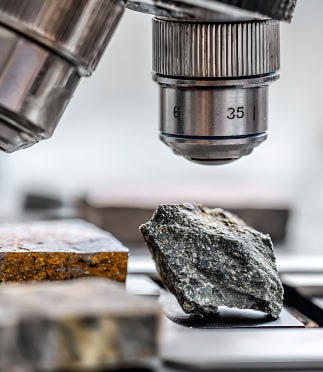
Determines isotopic ratios and trace element compositions in minerals, meteorites, and planetary materials for origin and evolution studies.

Forensics
Identifies trace residues, particulates, and isotopic signatures to authenticate evidence and support investigations with nanoscale precision.
Complementary Techniques
- Time of Flight Secondary Ion Mass Spectroscopy (ToF-SIMS): Broad mass range detection, ideal for molecular and organic species with large-area imaging capabilities.
- Transmission Electron Microscopy (TEM): Atomic-level structural and crystallographic imaging; excellent for morphology, with added elemental analysis via EDS/EELS.
- X-ray Photoelectron Spectroscopy (XPS): Provides chemical state and quantitative surface composition over microns, but less nanoscale resolution than NanoSIMS.
Time of Flight Secondary Ion Mass Spectroscopy (ToF-SIMS)
Ultra-sensitive surface analysis with chemical imaging & depth profiling. Explore
Transmission Electron Microscopy (TEM)
Images atomic structure, defects, interfaces with sub-nm resolution. Explore
X-ray Photoelectron Spectroscopy (XPS)
Measures surface elemental composition and chemical states. Explore
Why Choose Covalent for Your NanoSIMS Needs?
Covalent provides end-to-end support for your NanoSIMS projects through a dedicated partnership with a leading TRC NanoSIMS facility. Our team of scientists and engineers helps design the study, manage sample logistics, and interpret results, ensuring you get the full value from advanced NanoSIMS instrumentation. We prioritize clear communication, tailored reporting, and collaborative problem-solving to deliver high-quality, decision-ready data for your specific application.
Frequently Asked Questions
Identifying the right test can be complex, but it doesn’t have to be complicated.
Here are some questions we are frequently asked
What is the smallest feature size NanoSIMS can analyze?
NanoSIMS achieves spatial resolutions of ~50 nm, enabling analysis of ultra-fine features.
Can NanoSIMS quantify isotopic ratios?
Yes, it provides precise isotopic ratio measurements, critical for tracer studies and geochronology.
What sample types are unsuitable for NanoSIMS?
Highly volatile, wet, or beam-sensitive samples may not be compatible or may require special preparation steps.