

What is Total Reflection X-ray Fluorescence?
Total Reflection X-ray Fluorescence (TXRF) works by directing a collimated X-ray beam at a shallow, grazing angle onto a sample surface, typically a silicon wafer. At this low incident angle, total external reflection occurs, which restricts interaction to the near surface of the wafer. This minimizes background noise and enhances sensitivity to trace elements present on the surface. When atoms on the wafer surface are excited by the X-ray beam, they emit characteristic fluorescent X-rays, which are then detected and analyzed. The concentration of elements is quantified using reference standards.

Atomic-Scale Resolution
Detection Limit
Detects ultra-trace elemental contamination down to ~1E10 atoms/cm² on wafer and thin film surfaces

Multi-Mode Imaging
● Analysis Type
Provides non-destructive analysis with high sensitivity for surface and near-surface regions

Comprehensive Material Analysis
Wafer Compatibility
Compatible with standard 200 mm and 300 mm wafers; enables rapid, automated full-wafer mapping
Why Use Total Reflection X-ray Fluorescence?
TXRF is highly surface-sensitive and ideal for detecting trace metal contamination near the sample surface, because grazing incidence X-rays interact only with the top few nanometers of the sample.
The TXRF-V310 features automatic wafer handling, contamination mapping, and advanced software capable of quantifying elements at or below 1E10 atoms/cm². Its high sensitivity and repeatability enable analysis of cleaning processes, tools, and process contamination with greater accuracy and efficiency.

Surface Sensitivity
TXRF detects trace metal contamination confined to the top few nanometers of the sample, making it ideal for surface analysis.

Automation & Mapping
Advanced systems, such as the TXRF-V310, offer automated wafer handling and full-surface contamination mapping for increased throughput and precision.

Quantitative Accuracy
Capable of quantifying elements at or below 1E10 atoms/cm², TXRF delivers high sensitivity and repeatability for reliable contamination monitoring.


How Total Reflection X-ray Fluorescence Works
- Analytical Depth: TXRF provides quantitative information on elemental composition at the near-surface region of a sample, typically within the top few nanometers.
- Material Compatibility: This technique is compatible primarily with 200 mm and 300 mm semiconductor wafers. While silicon wafers are primarily analyzed other compound semiconductors can also be analyzed.
- Spatial Resolution: While TXRF does not offer high spatial resolution like imaging techniques, it can map contamination patterns across sample surfaces using automated stage movement with a resolution on the order of 5 -10 mm.
- Depth Profiling: TXRF is primarily a surface-sensitive technique and does not perform depth profiling for layered material analysis; it focuses on detecting elements at or near the surface.
Equipment Used for Total Reflection X-ray Fluorescence:
Rigaku TXRF V310
- Elemental detection range: Na (Z=11) to U (Z=92)
- Detection limit: Approximately 1E10 atoms/cm² (element-dependent)
- Compatible wafer sizes: 200 mm and 300 mm
- Atmosphere: Vacuum or helium purge
- Measurement modes: Single-point, multi-point, and mapping analysis
- Software: Automated element quantification and contamination trend analysis
- High-power W-anode X-ray source (9 kW rotating anode)
- Three excitation energies optimized for light, transition, and heavy elements
- XYθ sample stage for precise positioning
- Dual FOUP (Front Opening Unified Pod) load ports

Key Differentiators
TXRF is a technique distinguished by its exceptional surface sensitivity, ultra-trace detection limits, and non-destructive measurement, but it also has key technical constraints.
Strengths
- Ultra-trace sensitivity (detects as low as 1E10 atoms/cm²)
- Non-destructive analysis of wafer surfaces
- Requires minimal sample preparation
- High throughput enabled by automated wafer handling
- Offers excellent repeatability and reproducibility
- Wide elemental detection range (from Na to U)
- Enables contamination mapping and site-specific measurements
Limitations
- Primarily surface-sensitive; not suitable for bulk analysis
- Requires flat, reflective wafer surfaces
- Performance may be hindered by thick films or rough surfaces
- Offers limited lateral resolution compared to microscopy techniques


Unsure Whether TXRF Is Right for You?
Learn more about using Total Reflection X-ray Fluorescence services today.
Sample Information
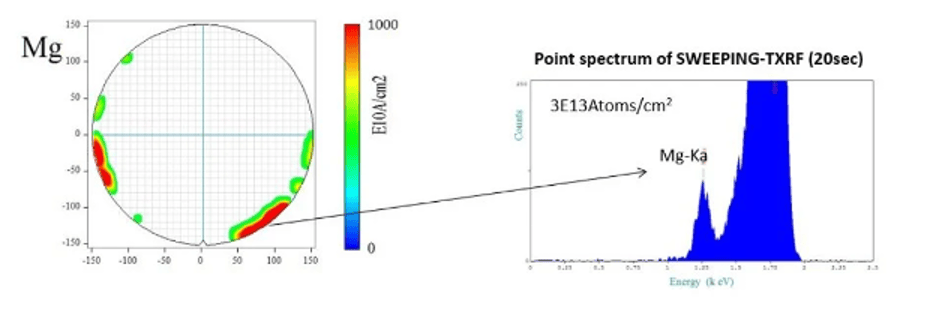
Map of the magnesium contamination across a wafer surface
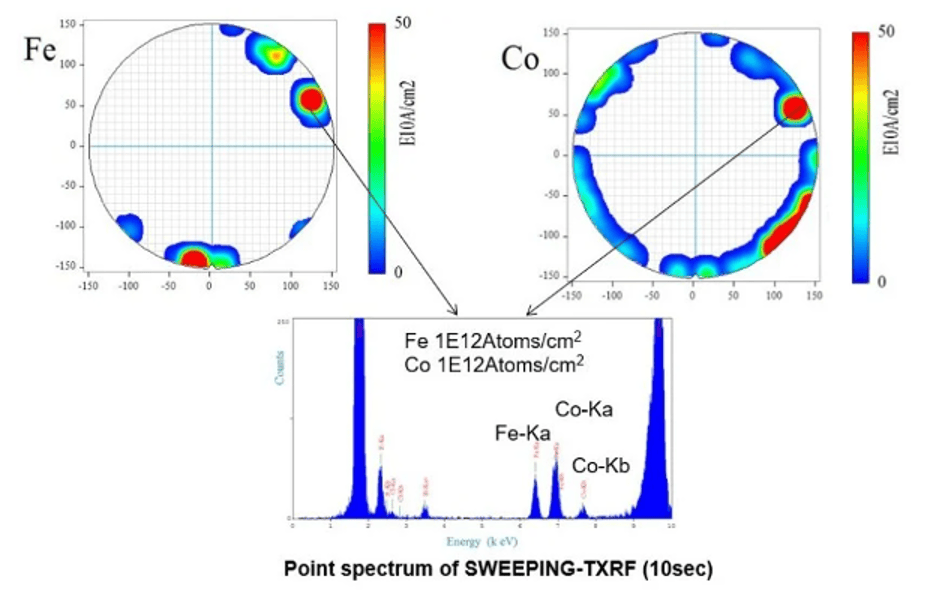
Map of Iron and Cobalt contamination across a wafer surface
What we accept:
- Samples must have flat, polished surfaces (e.g., silicon wafers)
- Compatible wafer sizes: 200 mm and 300 mm
- Surfaces must be free of debris and water droplets
- Surface must be dry and free of particles
- Compatible with materials used in semiconductor processing

Use Cases
Semiconductor
The main application of TXRF is ultra-trace, non-destructive elemental contamination monitoring of semiconductor wafers and thin films.
Complementary Techniques
- Wavelength Dispersive XRF (WDXRF) and Energy Dispersive XRF (EDXRF): Provide complementary elemental analysis with sensitivity to both bulk and surface layers.
- Secondary Ion Mass Spectrometry (SIMS): Offers high-sensitivity elemental analysis for both surface and bulk materials.
- Time-of-Flight SIMS (TOF-SIMS): Offers high-sensitivity analysis of organic contamination on wafer surfaces.
- X-ray Photoelectron Spectroscopy (XPS): Provides complementary chemical state analysis of surface elements.
- Particle Surface Contamination Inspection (PSC): Identifies and quantifies particle contamination on wafer surfaces.
Scanning Electron Microscopy (SEM)
Images surface topography and composition with electrons. Explore
Scanning Transmission Electron Microscopy (STEM)
Provides atomic-scale imaging and spectroscopic mapping. Explore
X-ray Diffraction (XRD)
Non-destructive analysis of crystal phases, lattice, and strain. Explore
Frequently Asked Questions
Identifying the right test can be complex, but it doesn’t have to be complicated.
Here are some questions we are frequently asked.
What is the difference between TXRF and EDXRF?
TXRF (Total Reflection X-ray Fluorescence) uses a grazing incidence X-ray beam, making it highly surface-sensitive and ideal for trace analysis on flat substrates. EDXRF (Energy Dispersive X-ray Fluorescence), in contrast, uses a direct incidence beam and is more suitable for bulk analysis, with less surface sensitivity and typically higher detection limits.
What is the difference between TXRF and conventional XRF?
TXRF differs from conventional XRF in that it employs total external reflection, which significantly reduces background noise and enhances sensitivity to trace elements on the surface. Conventional XRF is better suited for bulk or thick samples and generally does not achieve the same low detection limits for surface contamination.
Can TXRF be used for depth profiling?
TXRF is primarily a surface-sensitive technique and cannot perform depth profiling. It detects and quantifies elements present at or near the sample surface, generally within the top few nanometers.
What types of samples are ideal for TXRF analysis?
TXRF is best suited for semiconductor wafers. Samples should be free of debris, water droplets, and surface roughness to achieve optimal results.
Can TXRF detect light elements like hydrogen or carbon?
TXRF has limited sensitivity for light elements such as boron and carbon due to their low fluorescence yields. Heavier elements (above sodium) are detected with much higher sensitivity.
Can TXRF provide quantitative results?
Yes, TXRF can provide quantitative results when calibrated with appropriate reference standards. The technique enables the determination of absolute concentrations of elements present at the sample surface.
What factors can affect the accuracy of TXRF results?
Factors affecting TXRF accuracy include sample flatness, cleanliness, matrix effects, calibration quality, and instrument stability. Proper sample preparation and the use of suitable reference standards are essential for reliable results.

Resources