
What Is Wavelength Dispersive X‑Ray Fluorescence (WDXRF)?
Wavelength Dispersive X-ray Fluorescence (WDXRF) is a non-destructive analysis technique used to measure the elemental composition of a given material. WDXRF testing services do so by measuring the characteristic X-ray fluorescence that is generated when a sample is excited by X-rays. The X-ray fluorescence is measured using a range of high-resolution crystal analyzers.

High-Resolution Analysis
High-Resolution Analysis
Separates X-ray wavelengths for precise elemental identification.

Wide Element Range
Wide Element Range
Measures elements from Be (Z=4) to U (Z=92).

Thin Film Capability
Thin Film Capability
Detects film thickness from ~1 nm to several microns.
Why Use WDXRF?
WDXRF spectroscopy provides rapid and non-destructive quantification of the composition of bulk materials and thin films. It also measures film thickness and impurity levels in thin films. Wavelength Dispersive X‑Ray Fluorescence enables verification of metal film deposition, control over process drift, and identification of contamination that could affect device performance.

Non-Destructive
Samples remain intact during testing.

Rapid and Reliable
Fast, accurate quantification for quality control.

Contamination Detection
Identifies trace impurities in coatings and materials.

Covalent’s Capabilities Offer WDXRF for
Non‑Destructive High‑Resolution Elemental
Analysis
Working Principle
Wavelength Dispersive X-ray Fluorescence (WDXRF) works by using X-rays to irradiate a sample. This process causes the atoms in the sample to emit fluorescent X-rays. These emitted X-rays have specific wavelengths characteristic of the elements present in the sample. Unlike Energy Dispersive X-ray Fluorescence (EDXRF), WDXRF spectroscopy separates these emitted X-rays’ wavelengths by using crystals to diffract the X-rays. This provides superior spectral resolution to resolve interference from nearby peaks and improve accuracy in complex samples.
The AZX 400 detects and quantifies elemental concentrations by measuring the intensity of characteristic X-rays using automated multi-crystal spectrometers. The instrument is operated under vacuum or purged with helium to enhance sensitivity, particularly for light elements. This allows for the detection of ultra-thin films and trace contamination, even in complex stacks or low-Z materials. Quantification can be performed using known standards or models based on fundamental parameters.
Equipment Used for WDXRF:
We use the Rigaku AZX 400 high-resolution WDXRF spectrometer designed for precise, non-destructive elemental analysis. Capable of measuring elements from Be (Z=4) to U (Z=92), it supports sub-ppm detection limits and thin film measurements from ~1 nm to several microns. With advanced automation, a variety of analyzing crystals, and vacuum-controlled sample chambers, it delivers reliable results while optimizing throughput for high-volume semiconductor and materials testing applications.
Rigaku AZX 400
Some key features include:
- Measures a variety of sample types: 10–400 mm wafers, coupons, and sputtering targets (up to 30 kg).
- Analytical flexibility for elements from Be to U, ideal for process R&D and low-volume, high-mix environments.
- Core attributes: 4 kW sealed X-ray tube, sequential-type goniometer, primary beam filter.
- Measurement spot sizes: 30, 20, 10, 1, and 0.5 mm diameter.
- Core options: Wafer Loader, SQX (Scan Quant. X) software, CCD Camera.
- Data processing: External PC with MS Windows® OS.
- Software capabilities: Simultaneous film thickness and concentration analysis, Fundamental Parameter software for thin film studies.

Key Differentiators
| Property | WDXRF |
|---|---|
| Element Range | Be (Z=4) to U (Z=92) |
| Detection Limits | Sub-ppm to percent levels |
| Film Thickness Range | ~1 nm to several microns |
| X-ray Tube | 4 kW Rh target |
| Detectors | Scintillation counter for heavy elements, flow proportional counter for light elements |
| Goniometer | Independent θ-2θ with 0.0005° reproducibility |
| Sample Stage | Automated R-theta |
| Diaphragm | 7-position with attenuators |
| Crystal Changer | Automatic, with LiF (200), Ge, PET, RX9, RX25, RX35, RX45, RX61, RX75 |
| Sample Chamber | Vacuum with Automatic Pressure Control |
| Analysis Software | Fundamental Parameters for quantitative analysis |
| Wafer Handling | Automatic transfer of 300 mm wafers from SEMI-compliant FOUP/FOSB |
Strengths
- Thin films & multilayers accuracy.
- Non-destructive analysis.
- Light & heavy elements.
- Ppm to 100% dynamic range.
- Automated, production-ready platform.
- Minimal prep.
- Inline/QA monitoring long-term stability.
- Quantitative analysis without standards.
Limitations
- Lower throughput for quick screening.
- Needs flat and uniform samples.
- Vacuum or a helium atmosphere is not compatible with volatile samples.
- Limited to surface/near-surface layer analysis.
- Large footprint instrument.


Sample Information
- Elemental Quantification: Tables showing atomic percentages of elements in thin films or coatings for precise composition analysis.
- Film Thickness Profile: Graphical plots across wafers to verify uniformity of sputtered or plated layers.
- Contamination Mapping: Heat maps highlighting trace elements to identify cross-contamination sources in process tools.
- Qualitative Analysis: Intensity vs. angle (2θ) plots with peak identification for verifying material phases and purity.
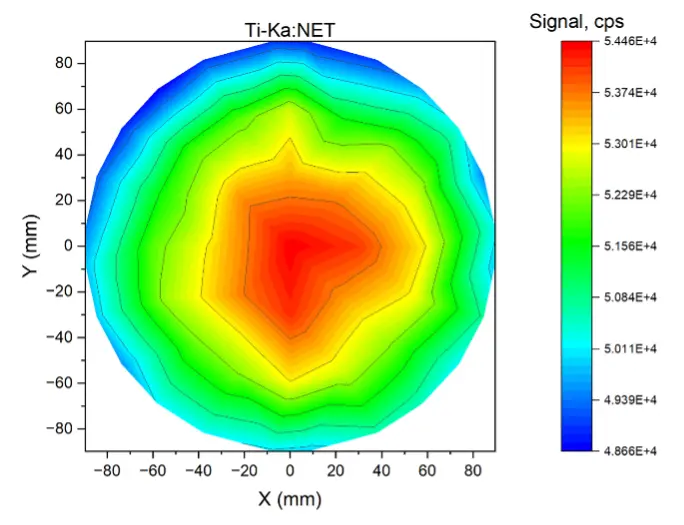
Variation of the Ti X-ray fluorescence signal over a TiN coated wafer.
What we accept:
- Flat, solid samples: wafers, films, or coupons.
- No volatile or vacuum-incompatible materials.
- Clean surface, free of particles or debris.
- Maximum size: 400 mm diameter × 50 mm thick, up to 30 kg.
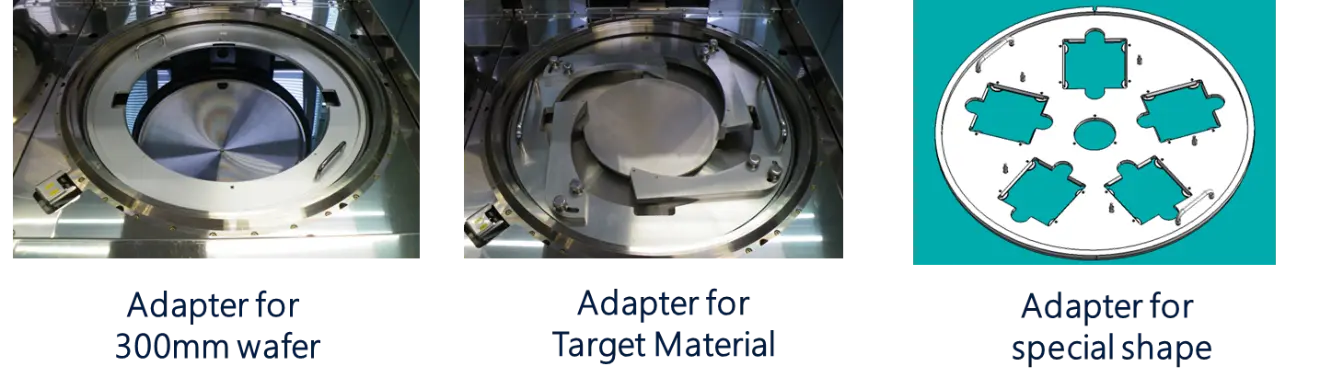
- Adaptable for wafers (up to 300 mm), coupons, sputtering targets, and irregularly shaped samples.
Not sure if your sample qualifies? Talk to our experts for prep guidance and optimal data quality. Other instruments are available to measure powders through Covalent partners.
Use Cases

Semiconductor Manufacturing
Analyze front-end and back-end wafers, coatings, and interconnects for elemental composition, film thickness, and contamination.
Compound Semiconductors
Measure materials like GaN, SiC, and InP for uniformity, purity, and process control.
Data Storage Media
Verify composition and layer thickness in hard drives, magnetic films, and advanced storage devices.

Solar & Photovoltaics
Assess thin-film solar panels, OLED, and LCD displays for uniformity, contamination, and material quality.
R&D & Advanced Packaging
Support research labs with elemental quantification, thickness mapping, contamination analysis, and phase identification.
Complementary Techniques
- Auger Electron Spectroscopy (AES): Detects low-energy Auger electrons emitted after electron beam excitation.
- Energy Dispersive X-ray Fluorescence (EDXRF): provides a faster way to measure the energy of emitted X-rays instead of separating them by wavelength but is less sensitive and susceptible to interferences from peak overlaps.
- Glow Discharge Optical Emission Spectroscopy (GDOES): Uses glow discharge plasma to sputter material while simultaneously recording optical emission from excited atoms.
- Rutherford Backscattering Spectrometry (RBS): Uses energetic helium ions scattered from a sample surface to determine composition and thickness.
- Secondary Ion Mass Spectrometry (SIMS): Provides depth profiling with nanometer resolution by using a destructive technique.
- Total Reflection X-ray Fluorescence (TXRF): A variation of XRF that uses grazing-incidence X-rays to minimize background signal. Given that it is highly sensitive, it is great to use for detecting trace contamination.
- X-ray Photoelectron Spectroscopy (XPS): Measures binding energies of emitted electrons from a given surface to deliver chemical state information.
Auger Electron Spectroscopy (AES)
Measures Auger electrons for high-resolution surface analysis. Explore
Energy Dispersive X-ray Fluorescence (EDXRF)
Quick, non-destructive material composition & thickness analysis. Explore
Glow Discharge Optical Emission Spectroscopy (GDOES)
Sputters surfaces to quantify composition & depth-profile layers. Explore
Rutherford Backscattering Spectroscopy (RBS)
Quantifies elemental composition and thin-film thickness. Explore
X-ray Photoelectron Spectroscopy (XPS)
Measures surface elemental composition and chemical states. Explore
Why Choose Covalent for Your WDXRF Needs?
Frequently Asked Questions
Identifying the right test can be complex, but it doesn’t have to be complicated.
Here are some questions we frequently get asked.
Why use WDXRF Analysis vs. EDXRF?
Wavelength Dispersive X‑Ray Fluorescence offers a higher resolution and can therefore resolve peak overlaps that complicate the analysis of EDXRF spectra.
What types of materials can be analyzed by Wavelength Dispersive X‑Ray Fluorescence?
WDXRF testing services are best used for flat, solid samples such as wafers, thin films, coatings, and sputtering targets. Irregular samples can also be measured, but it will require proper adapters.
Is WDXRF Analysis Destructive to Samples?
No. WDXRF spectroscopy is a non-destructive technique, meaning samples remain intact and there is no damage done to them during the testing process.
What are the sample size and weight limits?
Samples can be up to 400 mm in diameter, 50 mm thick, and weigh up to 30 kg.
What are some of the limitations of Wavelength Dispersive X‑Ray Fluorescence?
Limitations include having a lower throughput compared to techniques like TXRF for quick screening and having a larger footprint instrument compared to handheld or benchtop XRF. It also requires samples to be flat and uniform. It’s important to note that a Vacuum or helium atmosphere may not be compatible with volatile samples and is typically limited to surface or near-surface layer analysis.

Resources