


What is DPC?
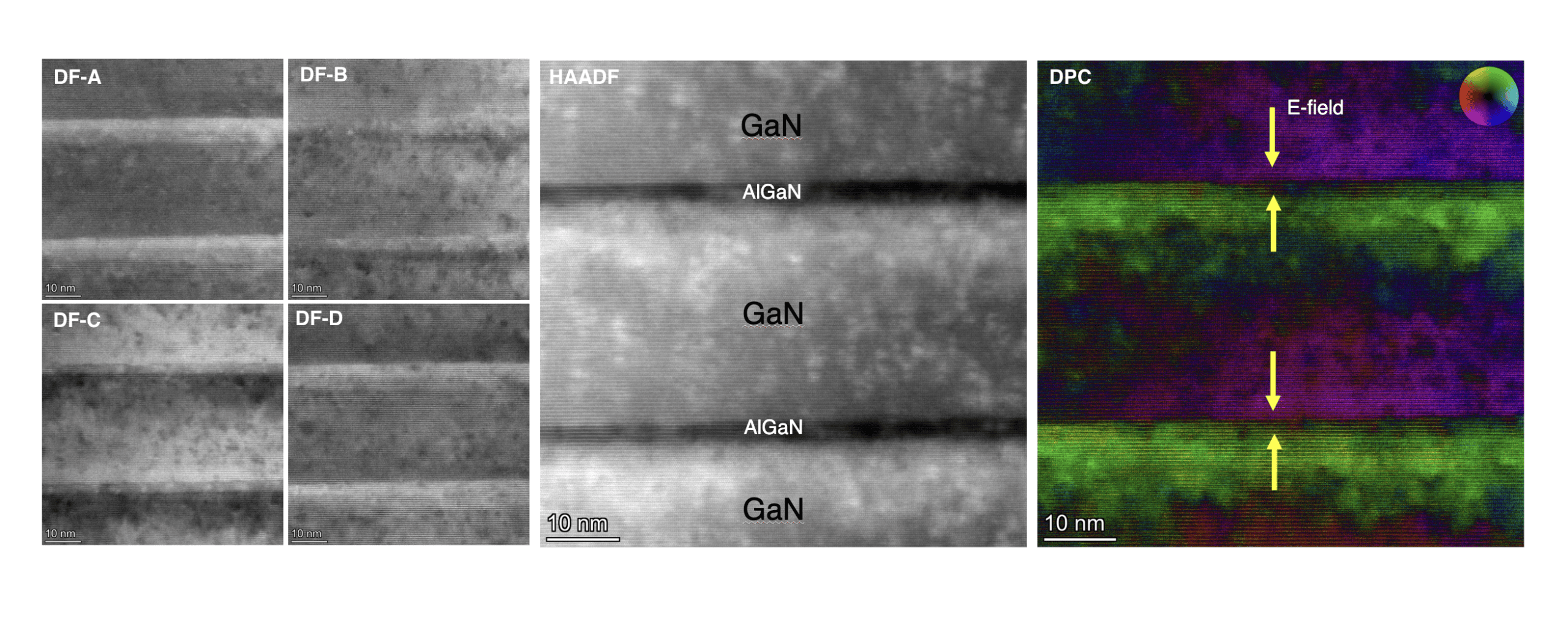
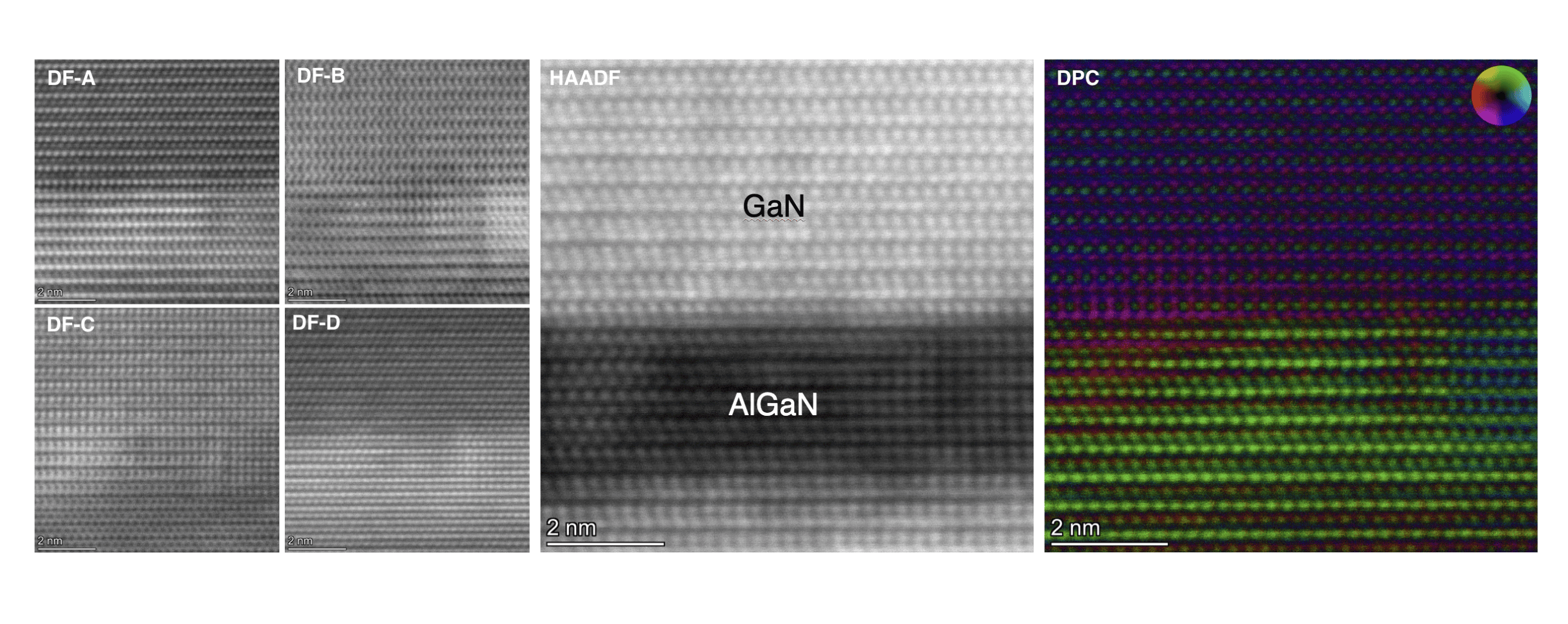
Differential Phase Contrast (DPC) STEM is a technique that maps internal electric or magnetic fields by measuring subtle beam deflections as the electron probe scans across a sample, using a segmented detector to quantify direction and magnitude.
Why use DPC?
DPC reveals how local charge, polarization, and fields behave at the nanoscale—providing direct insight into functional properties that cannot be inferred from structure alone.

Direct electric field mapping
Measures beam deflection at each pixel to map local electric and magnetic fields in real space.

Sensitive to charge and polarization
Reveals subtle variations in charge distribution and polarization that are invisible in conventional imaging.

Structure-to-function insight
Connects microstructure to functional behavior by showing how local fields respond.


Working Principle
DPC uses a segmented detector located underneath the sample to measure the beam deflection at each pixel. Areas of the sample that are electrically polarized will deflect the beam and intensity differences are then converted into field direction and relative strength maps.

Equipment used for DPC:
We use the Talos™ F200X G2 TEM with Super-X EDS system for DPC and other Transmission Electron Microscopy needs.
Talos™ F200X G2 TEM
- Talos has the Super-X EDS system with 4 SDD detectors, helping with faster EDS data acquisition.
- TEM Line Resolution: ≤ 0.10 nm.
- STEM Resolution: ≤ 0.16 nm.
- Maximum Tilt Angle with Double Tilt Holder: ± 35° alpha tilt / ± 30° beta tilt.
- Maximum Diffraction Angle: 24°.
- Electron Source: High-Brightness Field Emission Gun.
- Gatan OneView CCD: 16MP 4K camera.
- Quad-EDS Detectors for enhanced sensitivity and detection limits.



Sample Information
What we accept:
- Vacuum stable bulk samples, either conductive for FIB-based lamella preparation or samples can be coated with metal onsite at Covalent to mitigate charge artifacts during prep.
- OR, if you’d like to prep the samples yourself:
- Thin, electron-transparent lamella with a thickness of less than about 100nm.