
What Is High-Performance Liquid Chromatography (HPLC)?
HPLC is a separation technique that pumps a liquid sample, carried in a solvent (the mobile phase), at high pressure through a column packed with fine particles (the stationary phase). Each compound interacts with the stationary phase to a different degree, so components leave the column at different retention times and reach the detector one by one.
Because the separation happens in solution at or near room temperature, HPLC handles compounds that GC-MS cannot: larger, moderately polar, non-volatile or thermally labile molecules. With UV detection, we quantify known compounds against reference standards and compare impurity profiles across samples.
Broad Compound Coverage
Quantitative Precision
Reversed-Phase Versatility
Why Use HPLC?
HPLC is the workhorse for purity and composition testing across pharmaceuticals, chemicals, polymers, medical devices and battery materials. It answers the questions most quality and R&D teams ask first: how pure is it, how much is there, and what else is in it?
Purity and Assay
Trace Impurity Detection
Supplier Qualification
How HPLC Works
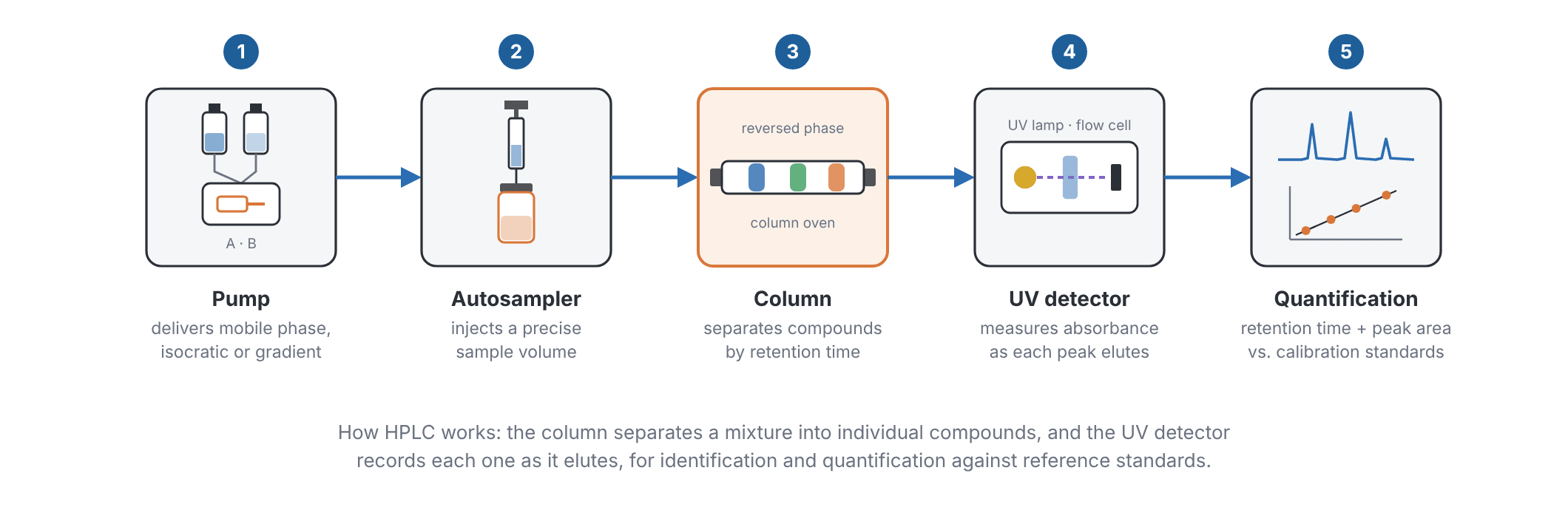
A high-pressure pump (1) delivers the mobile phase at a constant flow, either at a fixed composition (isocratic) or with a programmed solvent gradient. An autosampler (2) injects a precise volume of the sample into the flow stream. The sample then passes through the analytical column (3), held in a temperature-controlled oven, where its components separate according to how strongly they interact with the stationary phase.
As each component elutes, the UV detector (4) measures its absorbance at the selected wavelength, producing a chromatogram of peaks versus retention time. Software (5) integrates each peak: retention time identifies a compound against a standard, and peak area gives its concentration through a calibration curve.
HPLC at Covalent
- Reversed-phase HPLC: C18 and related columns with isocratic or gradient water/organic solvent mobile phases, for most non-polar to moderately polar organic compounds.
- UV detection: quantification of compounds with a UV chromophore, at a wavelength selected for each analyte.
- Method adaptation and development: run your existing method, adapt a standard method, or develop a new reversed-phase method for your sample.
Equipment Used for HPLC

PerkinElmer LC 300 Analytical HPLC System
- Reversed-phase separations with isocratic and gradient elution.
- UV detection for assay, purity and impurity analysis.
- Autosampler with integrated column oven and preheater.
- Built-in solvent degassing and automated priming.
- SimplicityChrom chromatography data system.
Key Differentiators
Strengths
- Wide applicability: handles non-volatile and thermally labile organic compounds without derivatization or vaporization.
- Quantitative accuracy: calibrated results with strong repeatability for assay and impurity work.
- High throughput: automated injection lets large sample sets run unattended, including overnight.
- Established methods: standard and industry reversed-phase methods can be run or adapted, and results are comparable across labs.
Limitations
- Compounds need a UV chromophore; those without one give weak or no signal.
- UV detection identifies peaks only by retention time against a standard; unknowns need LC-MS, GC-MS or NMR for identification.
- Quantification needs a reference standard for each target compound; area-percent results are relative.
- Very polar or ionic compounds are poorly retained in reversed phase.
- Samples must be fully soluble in a solvent compatible with the mobile phase.
- Volatile compounds and permanent gases are better suited to GC-MS.
Example Outputs
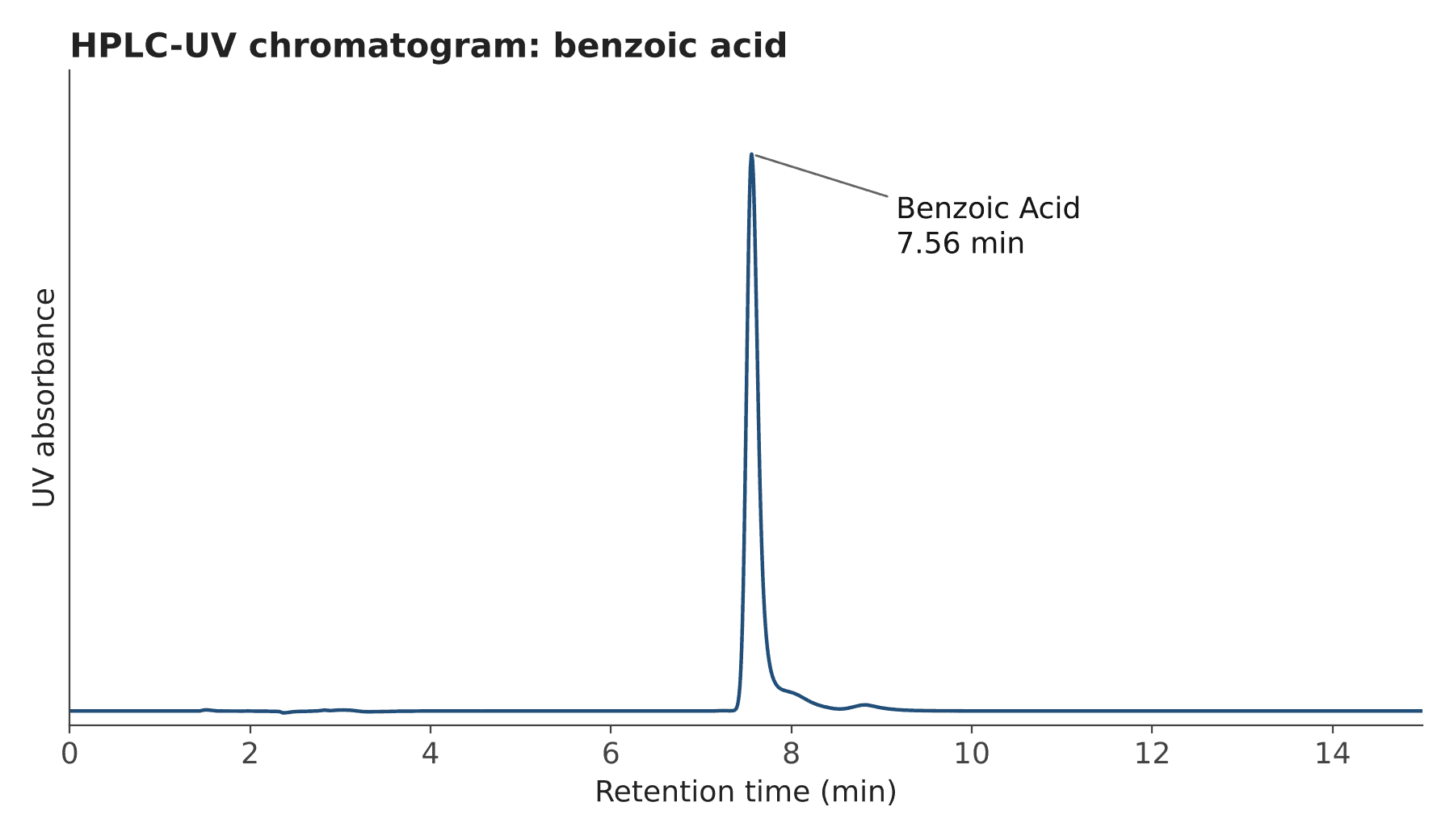
Reversed-phase HPLC-UV chromatogram of a benzoic acid standard. Benzoic acid elutes at 7.56 min.
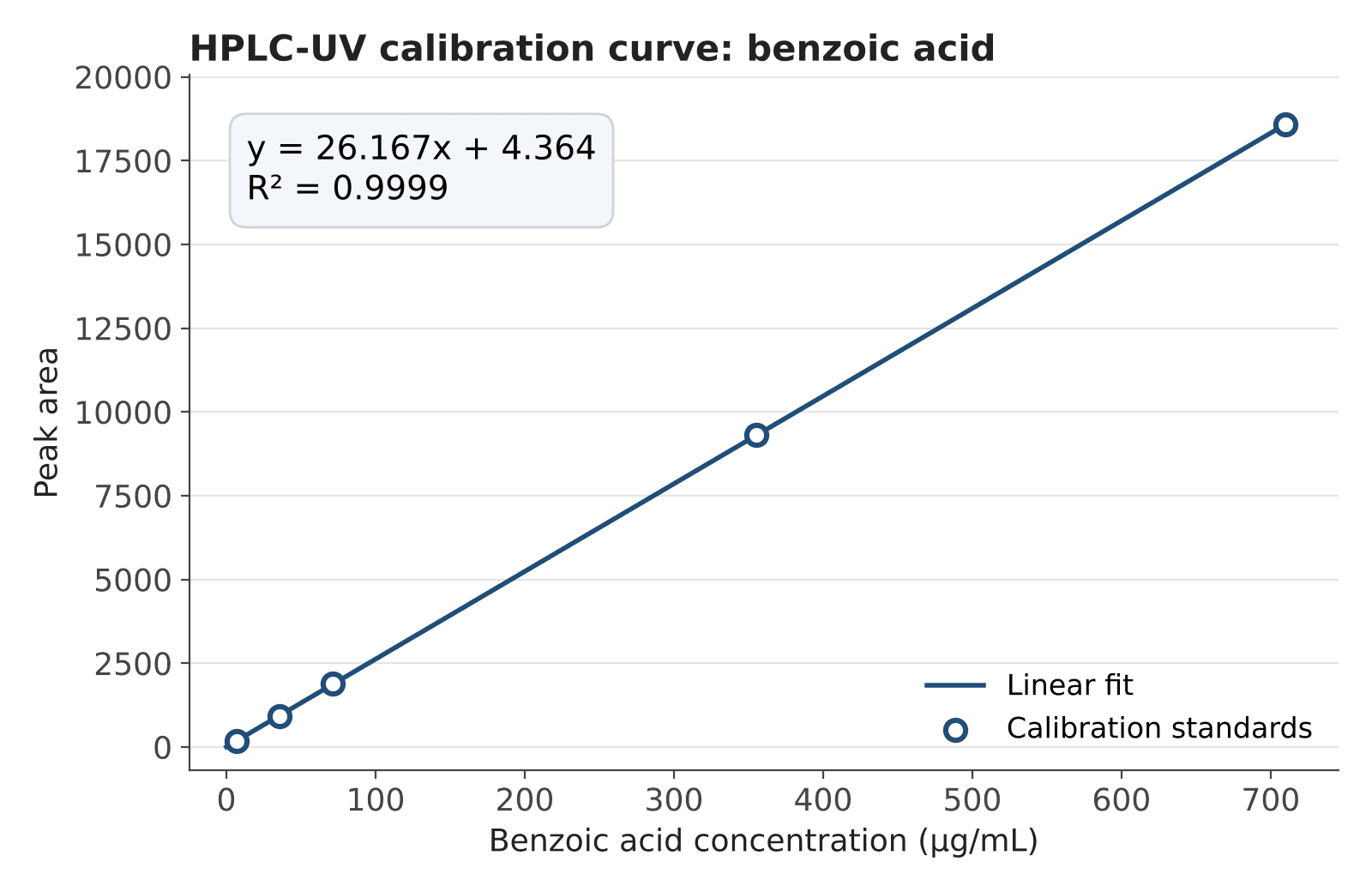
Calibration curve for benzoic acid by HPLC-UV at 230 nm, linear from 7.1 to 710 µg/mL (R² = 0.9999).
Each report includes the chromatograms, peak table (retention time, area, area %), calculated concentrations where standards are used, method conditions and expert interpretation.
Sample Requirements
- Forms: liquids, solutions and solids that dissolve or can be extracted into a suitable solvent.
- Amount: typically 10 to 50 mg of solid or 1 to 5 mL of liquid.
- Standards: provide reference standards for target compounds when quantitation is needed, or tell us which compounds to source.
- Stability: note light, air or temperature sensitivity; ship chilled or protected from light if required.
- Context: share any known composition, existing methods or SDS so we can select the column and mobile phase.
HPLC Applications by Industry
Pharmaceuticals & Biotech
Purity assay, related substances, degradation products and stability testing.
Medical Devices
UV-active non-volatile extractables and leachables (E&L), alongside GC-MS and ICP-MS.
Energy Storage
UV-active electrolyte additives, impurities and decomposition products.
Polymers & Plastics
Antioxidants, UV stabilizers, plasticizers, residual monomers and oligomers.
Chemicals & Specialty Materials
Raw material purity, lot-to-lot consistency and impurity profiling.
Food, Agriculture & Consumer Products
Preservatives, vitamins, active ingredients and contaminants.
Environmental Testing
UV-active organic contaminants in water, soil and leachate samples.
Techniques That Complement HPLC
HPLC Testing Services at Covalent
Covalent runs reversed-phase HPLC with UV detection on a PerkinElmer LC 300 system to answer purity and composition questions for R&D, quality control and failure analysis teams. Our scientists select the column, mobile phase and detection wavelength for each sample, adapt existing or standard methods, or develop new ones when needed. Every project includes data review and interpretation by an experienced chemist, and results can be combined with GC-MS, NMR and ICP-MS when unknowns need identifying or elemental data is required. For techniques we don't run in-house, such as LC-MS, we can place work through Covalent Connect, our network of trusted partner labs.
Turnaround is typically 5–7 business days, with rush options available at an extra cost.