
What Is Infrared Thermography (IRT)?
Infra-Red Thermography (IRT) is a non-destructive testing technique that visualizes temperature variations on a material’s surface to reveal hidden defects and assess thermal performance. By capturing infrared radiation and converting it into detailed thermal images, IRT enables precise, real-time inspection of electronic components, materials, and devices under operation. Ideal for detecting hotspots, delaminations, and other anomalies, it provides a fast, contact-free way to ensure reliability and quality across applications.
Infrared thermography (IRT) is a non-contact, non-destructive technique that uses an infrared camera to map temperature across a sample’s surface. Every object emits infrared radiation that increases with temperature, so a thermal image (thermogram) shows where a part is hotter or cooler than expected. In electronics failure analysis, IRT is used to find the hotspot created by a short, leakage path or failing component while the device is powered. In materials, it reveals delamination, voids and uneven heating.
Dual-Mode Imaging
High Sensitivity
Real-Time and Non-Contact
Why Use IRT?
IRT gives a full-field view of where heat is generated in seconds, without touching or damaging the sample. In electronics, it narrows a failure down from a whole board or package to a single component or die region before destructive steps such as decapsulation or cross-sectioning. It is also used to check thermal design, compare good and failing units, find poor solder or thermal-interface contact, and screen batteries, solar cells and composites for hidden defects.
Early Defect Detection
Improved Reliability
Wide Industry Use
How Infrared Thermography Works
Heat is either generated inside the sample or applied from outside (1). In passive thermography, the device is powered with an electrical bias so that faults heat up on their own. In active thermography, a flash lamp, laser or hot air pulse heats the surface, and defects such as delamination change how that heat spreads. The sample emits infrared radiation in proportion to its temperature (2). A cooled InSb camera sensitive to 3–5 µm wavelengths captures that radiation (3). Software corrects for surface emissivity and converts the signal to a calibrated temperature map, or thermogram, where the hotspot or defect shows as a localized temperature difference (4). Subtracting an unpowered reference image from a powered one removes background patterns and makes small hotspots easier to see.
Equipment Used for IRT
Covalent uses the FLIR ThermoVision SC6000 IR camera for advanced Infra-Red Thermography inspections. This high-performance system enables precise, non-contact thermal imaging for detecting surface and subsurface temperature variations across a wide range of materials and devices.

FLIR ThermoVision SC6000 IR
- Detector Type: Indium Antimonide (InSb) for high-sensitivity thermal detection.
- Spectral Range: 3.0 to 5.0 microns for accurate infrared capture.
- Temperature Range: -25 to +500 °C to accommodate diverse applications.
- Temperature Sensitivity: As low as 0.018 °C for detecting subtle variations.
- Adjustable Frame Rate: 0.0015 Hz to 126 Hz for real-time and dynamic thermal imaging.
Key Differentiators
Covalent pairs IR thermography with in-house electrical testing, X-ray, decapsulation, cross-sectioning and SAM, so a hotspot found by IRT can be followed straight to its physical root cause in the same lab.
Strengths
- Non-contact and non-destructive: suitable for live, powered devices.
- Fast: full-field imaging finds hotspots in seconds.
- Passive and active modes: covers both powered faults and subsurface defects.
- Sensitive: detects temperature differences of a few hundredths of a degree.
Limitations
- Emissivity: surface finish and color affect readings. Polished metals may need a matte coating.
- Environment: air currents, reflections and nearby heat sources reduce accuracy.
- Depth: subsurface detection depends on thermal diffusivity, layer thickness and the heating method.
- Resolution: spatial resolution is limited by the camera optics and detector pixel size, so very small features need a microscope lens.
Example Outputs
These outputs are essential for identifying thermal irregularities, assessing material performance, and supporting non-destructive failure analysis.
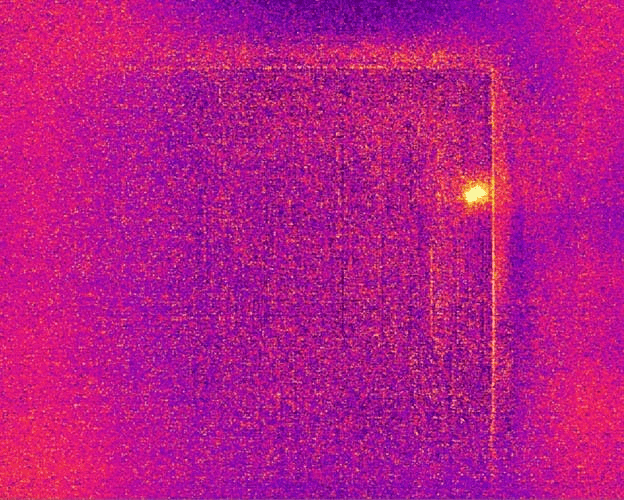
IRT image showing a hot spot in upper right corner of a flip-chip die: differential/subtraction mode.
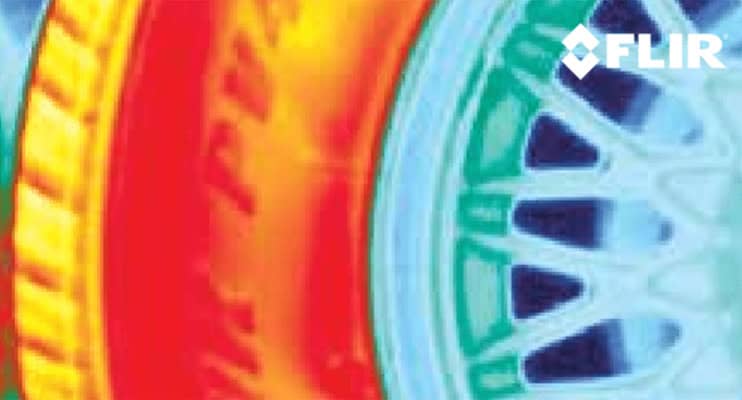
Thermal image captured of a spinning car tire.
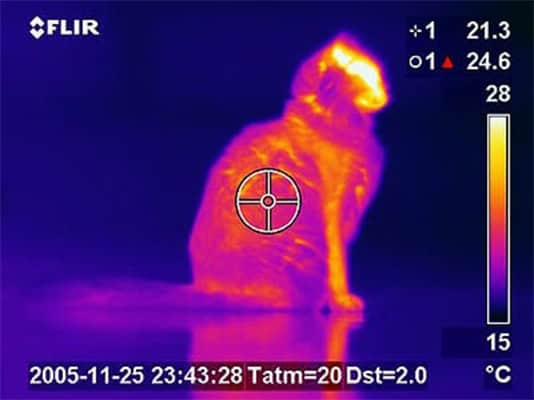
The Thermogram of a domestic cat: apparently captured while it was deep in thought, as it is showing increasing temperatures near its brain and in its face.
Sample Requirements
- Must have an accessible, clean surface for thermal imaging.
- Flat or slightly contoured surfaces yield the most reliable data.
- Highly reflective or low-emissivity materials (e.g., polished metals) should be coated with a temporary matte finish to improve emissivity.
- Samples should be stable under mild thermal excitation (if active thermography is used).
- Height clearance must accommodate the optical setup of the thermal camera.
- For powered testing, send the device with its operating conditions (voltage, current, pinout) or a test fixture.
- If you can, send a known-good unit for comparison.
Infrared Thermography Applications by Industry
Electronics & Semiconductor
Battery & Energy Storage
Medical Devices & Biotech
Solar & Photovoltaics
Materials Science & Manufacturing
Techniques That Complement IRT
IR Thermography Testing Services at Covalent
Covalent performs IR thermography in our Sunnyvale Core Lab with a FLIR SC6000 mid-wave infrared camera for electronics failure analysis, battery and energy storage, and materials inspection. Our engineers power devices under your operating conditions, or apply external heating, to locate hotspots and defects, then follow up in-house with X-ray, decapsulation, cross-sectioning or SAM to find the root cause. Each report includes calibrated thermograms with the hotspot locations and temperatures marked.
Frequently Asked Questions
What is Infrared Thermography (IRT)?
Infrared thermography is a non-destructive testing method that captures and visualizes the heat patterns and distribution of an object’s surface. It easily allows for visualization of temperature changes across a part or a device. Our infrared inspection services stand out in their usefulness in detecting hidden defects, understanding material performances, as well as monitoring thermal events during operation.
What types of samples can be analyzed through IRT thermal imaging inspection?
What are the common applications of IRT at Covalent?
How well can IRT detect subsurface defects?
Even though thermal imaging inspection is primarily surface-sensitive, aactive thermography, which uses an external heat source, allows for enhanced visibility of subsurface defects. The effective depth depends on the material’s thermal diffusivity, thickness of layers, and type of excitation, such s flash, lock-in, and pulse.
What are the spatial and thermal resolutions?
What is the difference between active and passive thermography?
Do I need to apply a coating to my sample?
Can IRT be used on live electronic devices?
What are the limitations of IRT?
There are several factors that may reduce accuracy, such as the object’s poor surface properties or environmental factors, such as air flow and ambient light will also affect the readings. Deeper defects may not be visible without active methods. However, Covalent’s team accounts for these factors with careful calibration and setup.
How is IR thermography used in failure analysis?
The failing device is powered under its normal or stressed conditions, and the IR camera locates the hotspot created by a short, leakage path or overstressed component. That location guides the next step, such as decapsulation, cross-sectioning or SAM, so destructive analysis targets the right area.